CDU/CSU Career
Four decades in the Christian Democratic Union: from general secretary and state chair in Schleswig-Holstein to the federal executive, the leadership of the CDU/CSU parliamentary group and, in 2025, the Foreign Office in a Merz-led government.
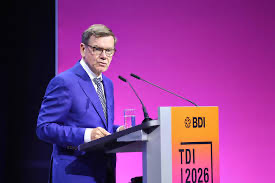
Johann Wadephul has never been one of the CDU's household names in the way that its chancellors and chairs have been. His career inside the party has instead followed a steadier path: regional organiser, state leader, member of the federal executive and, for the better part of a decade, the man the CDU/CSU parliamentary group sent out to speak on war, alliances and armed forces. That combination of party loyalty and specialist standing explains how a lawyer from Schleswig-Holstein became, in May 2025, the first CDU foreign minister since Gerhard Schröder left the office in 1966.
The Union: two parties, one group
Fact The "Union" in German politics refers to two separate parties. The Christian Democratic Union (CDU) organises in fifteen of the sixteen federal states; its sister party, the Christian Social Union (CSU), stands only in Bavaria. The two do not compete against each other in elections and, in the Bundestag, sit together as a single parliamentary group, the CDU/CSU-Fraktion. Within that group, members from each state also form a Landesgruppe, the CSU deputies forming by far the most autonomous of these.
This structure matters for understanding Wadephul's career. Party offices, such as state chair or membership of the CDU federal executive, sit in the CDU's own hierarchy. Parliamentary offices, such as deputy chair of the parliamentary group, belong to the joint CDU/CSU group and must accommodate CSU interests. Wadephul has held senior posts on both tracks, and several of the frictions of his time as foreign minister have run along the line between them.
Building a base in Schleswig-Holstein
Fact Wadephul joined the CDU and its youth wing, the Junge Union, in 1982. He chaired the Junge Union in his home district of Dithmarschen and, from 1992 to 1996, led the Junge Union in Schleswig-Holstein. He joined the CDU's state executive in 1993. His early years are told in more detail on the political beginnings page; what follows concentrates on the senior offices.
In 1997 he moved into the professional side of the state party, becoming its state manager (Landesgeschäftsführer) in April and general secretary from 1997 to 2000. English Wikipedia records that he served in that role under state chair Peter Kurt Würzbach. A general secretary in a German state party is the chair's chief organiser and campaign manager, responsible for messaging and the party machine rather than policy in a narrow sense.
In 2000 he succeeded to the top job, serving as CDU state chair from 2000 to 2002. He was elected to the Landtag in Kiel in the same year. His tenure as chair was short; Peter Harry Carstensen succeeded him and went on to lead the CDU back into government in 2005. Wadephul's parliamentary role in Kiel, culminating in the chairmanship of the CDU group in the Landtag from April 2005 during the grand coalition under Carstensen, is covered on the political beginnings page.
The district chair in Rendsburg-Eckernförde
Fact According to his Bundestag biography for the 19th legislative period, Wadephul has chaired the CDU district association (Kreisverband) of Rendsburg-Eckernförde since 30 January 2006. The district covers the constituency he has represented in the Bundestag since 2009, which he won directly in 2009, 2013, 2017 and 2025.
The post is not glamorous, but in German parties the district association selects the constituency candidate. Holding it gave Wadephul a secure local base from which to seek nomination, and it has kept him rooted in the rural north while his national work took him into foreign affairs. His results in the constituency are set out on the Bundestag career page.
The CDU federal executive
Fact In November 2010 Wadephul was elected to the CDU's federal executive (Bundesvorstand), the party's main national leadership body below the presidium. The Federal Foreign Office, the Federal Government, the Konrad Adenauer Foundation's history of the CDU and German Wikipedia all give his membership as 2010 to 2021. A summary on bundestag.de instead dates it from November 2010 to November 2020.
The discrepancy probably has a mundane explanation: the party congress that would have renewed the executive in late 2020 was postponed by the pandemic and held in January 2021, so outgoing members stayed in office until then. Either way, his membership covered more than a decade spanning Angela Merkel's final years as party chair, Annegret Kramp-Karrenbauer's chairmanship and the run-up to the 2021 leadership contest. No source shows him as a member of the CDU presidium, the smaller inner leadership.
Leader of the Schleswig-Holstein deputies
Fact On 7 March 2017 Wadephul was elected chair of the Schleswig-Holstein Landesgruppe of CDU members in the Bundestag, succeeding Ole Schröder, according to German Wikipedia. He was re-elected to the post in the 19th and 20th legislative periods, and his Bundestag biographies for both terms list the role.
A Landesgruppe chair speaks for the state's deputies inside the parliamentary group, coordinates their positions on questions that affect the state and represents them in the group's internal negotiations. For a state between the North Sea and the Baltic, many of those questions touch, increasingly, on security policy in the Baltic region.
Deputy chair of the parliamentary group
Fact The office that defined Wadephul's national profile was deputy chair of the CDU/CSU parliamentary group, with responsibility for foreign affairs, defence, the EU's common foreign and security policy (CFSP) and its defence arm (CSDP), and the Council of Europe. The start date is disputed: the Konrad Adenauer Foundation, the CDU's own website and both German and English Wikipedia give 2017, while the Federal Foreign Office and the Federal Government give 2018. The exact date of his first election could not be verified. He held the post until he joined the government in 2025.
According to English Wikipedia, he succeeded Franz Josef Jung, a former defence minister, and served under three successive group chairs: Volker Kauder, Ralph Brinkhaus and Friedrich Merz. German Wikipedia records that he was confirmed in the post in September 2022, after Merz had taken over the group.
English Wikipedia also states that he sat in the foreign-policy working group in the negotiations that produced Angela Merkel's fourth government, a group led by Ursula von der Leyen, Gerd Müller and Sigmar Gabriel.
In practice the deputy chair is the group's lead on his policy field. He coordinates the working groups on foreign affairs and defence, decides which members speak in plenary debates and negotiates with the coalition partner while in government or sets the line of attack while in opposition. From 2021 to 2025, when the Union sat in opposition to Olaf Scholz's government, that made Wadephul the CDU/CSU's principal voice on Russia's war against Ukraine. His record in those debates is set out on the Bundestag career and parliamentary work pages.
- 1982
- Joins the CDU and the Junge Union
- 1992–1996
- State chair, Junge Union Schleswig-Holstein
- 1997–2000
- General secretary, CDU Schleswig-Holstein (state manager from April 1997)
- 2000–2002
- State chair, CDU Schleswig-Holstein
- 2005–2009
- Chair of the CDU group in the Landtag, Kiel
- From 30 Jan 2006
- Chair, CDU district association Rendsburg-Eckernförde
- Nov 2010–2021
- Member, CDU federal executive (some sources: to November 2020)
- From 7 Mar 2017
- Chair, Schleswig-Holstein CDU Landesgruppe in the Bundestag
- 2017/2018–2025
- Deputy chair, CDU/CSU parliamentary group (foreign affairs, defence, CFSP/CSDP, Council of Europe)
- Since 6 May 2025
- Federal Minister for Foreign Affairs
A vote against the majority: marriage equality, 2017
Fact On 30 June 2017 the Bundestag voted to open civil marriage to same-sex couples. Chancellor Merkel had released her members from the party line, turning the question into a free vote. Most of the CDU/CSU group, including Merkel herself, voted against. According to German and English Wikipedia, Wadephul voted in favour, against the majority of his own group.
The 2021 leadership contest
Fact When Annegret Kramp-Karrenbauer gave up the CDU chair, three candidates ran to succeed her: Armin Laschet, Friedrich Merz and Norbert Röttgen. According to English Wikipedia, Wadephul publicly endorsed Röttgen, the former chair of the Bundestag's foreign affairs committee. Laschet won at the online party congress in January 2021. After the Union's defeat in the September 2021 federal election, Merz won the chairmanship at the next attempt and took office in early 2022.
Röttgen was the foreign-policy candidate of that contest, and backing him lined Wadephul up with the wing that wanted a harder line towards Moscow and Beijing. Supporting a candidate other than Merz had no visible cost: Merz later kept him as deputy group chair and made him foreign minister.
Working with Friedrich Merz
Fact Merz took over the parliamentary group in February 2022, days before Russia's full-scale invasion of Ukraine. For the three years that followed, Wadephul was his deputy for foreign and defence policy. He pressed the Scholz government over heavy weapons and the Taurus cruise missile, and the Union sharpened its opposition profile on both. When Merz formed his cabinet in May 2025, he gave the Foreign Office to the CDU for the first time in almost sixty years and appointed Wadephul to it.
The clearest public sign of the relationship came in November 2025, during the row over Wadephul's comments on returns to Syria. As criticism mounted inside the Union, Merz said: "Jo Wadephul ist ein guter Außenminister" ("Jo Wadephul is a good foreign minister"), while leaving the government's returns policy unchanged.
Coalition friction and party discipline
As foreign minister, Wadephul has faced pressure from two directions: from the coalition partner, the SPD, and from inside the Union itself. Both episodes below are examined in full on the controversies page.
The 5 per cent episode, May 2025
Fact At the NATO foreign ministers' meeting in Antalya on 15 May 2025, little more than a week after taking office, Wadephul said Germany would follow President Trump's call for allies to spend 5 per cent of GDP on defence: "Wir folgen ihm da" ("We follow him on that"). The SPD had understood that the coalition would not announce a figure before the NATO summit.
Criticism SPD MP Ralf Stegner called the idea "glatter Irrsinn" (sheer madness). Defence Minister Boris Pistorius said the percentage was "not so important" and that the defence budget was a matter for his department. The Greens called the statement "naive". NATO adopted the 5 per cent target, split into 3.5 per cent for core defence and 1.5 per cent for related infrastructure, at The Hague in June 2025, and Wadephul called the agreement a "great success".
Israel and "forced solidarity", May–June 2025
Criticism When Wadephul rejected "Zwangssolidarität" (forced solidarity) with Israel and tied further arms exports to a review of conduct in Gaza, the sharpest response came from the Union's own sister party. CSU leader Markus Söder said on ZDF on 4 June 2025 that the language went too far, and the CDU/CSU parliamentary leadership opposed any halt to arms exports.
Syria and returns, October–November 2025
Fact After visiting the destroyed Damascus suburb of Harasta on 30 October 2025, Wadephul said returns of Syrian refugees were possible only to a very limited extent in the short term. This cut across a central demand of his own party on migration.
Criticism Günter Krings, deputy chair of the CDU/CSU group, called the argument "entirely inappropriate". CSU general secretary Martin Huber said the war was over. At a heated group meeting in early November, participants reported him as saying that Syria looked worse than Germany in 1945 and that he was "no softie"; these remarks are known only from accounts of a closed meeting. Group chair Jens Spahn called for discipline in communication, and the Hesse Junge Union chair suggested he consider whether he was still the right person for the job. Wadephul clarified that his ministry actively supported the return of offenders and security risks, and later stood by his assessment as a sober analysis.
Where he stands in the party
The Merkel years
Analysis During Merkel's chancellorship, Wadephul was a loyal member of the governing group who gradually built a specialist reputation: rapporteur for the Middle East, the Gulf and Iran in the foreign affairs committee from 2013, and from 2017 or 2018 the group's lead on foreign and defence policy. He defended the NATO 2 per cent target in the Bundestag in July 2019 as a commitment made to the alliance, not to any US president. On Nord Stream 2 he reflected the government line of the time, saying in February 2021 that the Union was "not fans" of the pipeline but that it was an economic project and almost finished.
Opposition, 2021–2025
Analysis Opposition changed his role. Free of coalition discipline and facing an SPD-led government that he accused of hesitation on Ukraine, he became one of the sharpest critics of Olaf Scholz on arms deliveries. He headed the German delegation to the NATO Parliamentary Assembly and, with Merz as group chair, helped make support for Ukraine and higher defence spending defining themes of the Union's opposition.
The Merz era
Analysis As a minister, Wadephul has shown that his views do not always match the instincts of parts of his party. On Israel and Syria in particular, he has argued from international law and conditions on the ground in ways that drew criticism from the CSU and from the CDU's domestic-policy wing. On Russia, NATO and defence spending, by contrast, he has been fully in line with the chancellor and the party mainstream. A fuller account of his views is on the political positions page.
Party roles at a glance
Party and parliamentary-group offices, with the level of the organisation and the state of the sources.
| Office | Level | Period | Source note |
|---|---|---|---|
| State chair, Junge Union | Schleswig-Holstein | 1992–1996 | Bundestag biography; KAS |
| General secretary, CDU | Schleswig-Holstein | 1997–2000 | Bundestag biography; KAS gives November 1997 as start |
| State chair, CDU | Schleswig-Holstein | 2000–2002 | Federal Government; Bundestag; KAS |
| District chair, CDU | Rendsburg-Eckernförde | From 30 January 2006 | Bundestag biography (19th term) |
| Member, federal executive | CDU national | November 2010–2021 | Sources differ: some give November 2020 as the end |
| Chair, Landesgruppe | Schleswig-Holstein CDU deputies, Bundestag | From 7 March 2017 | German Wikipedia; role confirmed in Bundestag biographies |
| Deputy chair, CDU/CSU group | Bundestag | 2017 or 2018 to 2025 | Start year differs between official and party sources |
Sources
- German Bundestag: biography, 21st legislative period
- German Bundestag: biography, 20th legislative period
- German Bundestag: biography, 19th legislative period
- Federal Foreign Office: curriculum vitae
- Federal Government: curriculum vitae
- Konrad-Adenauer-Stiftung: Geschichte der CDU, biogram
- CDU: profile
- Wikipedia (German): Johann Wadephul
- Wikipedia (English): Johann Wadephul
- ZDF heute: Wadephul on the 5 per cent target
- AFP via Yahoo News: Germany split on NATO 5% defence target
- Jüdische Allgemeine: Söder criticises Merz and Wadephul
- ZDF heute: Merz backs Wadephul in the Syria row
- Berliner Zeitung: Wadephul defends remarks in the Union group
- Enab Baladi: Berlin divided on Syria deportations