Significance So Far
Johann Wadephul is roughly halfway through a parliamentary term as Foreign Minister. This is not a final judgement: it looks at what has already changed, what remains open and how supporters and critics read the record.
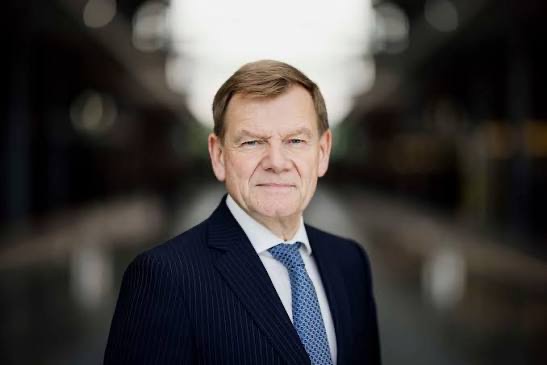
Legacies are written after the fact, and Johann Wadephul's tenure is far from over. He has been Foreign Minister since 6 May 2025, and the Bundestag elected in February 2025 runs until 2029. Any assessment in October 2026 is therefore provisional. Still, some things are already clear: the historical significance of his appointment, the kind of politician he is and the questions on which his record will finally be judged.
A historical break
Fact Wadephul is the first CDU politician to lead the Federal Foreign Office since Gerhard Schröder, who held it from 1961 to 1966. In the Federal Republic's first two decades the Foreign Office was firmly in Christian Democratic hands. Konrad Adenauer combined it with the chancellorship from 1951 to 1955, followed by Heinrich von Brentano and Schröder.
From 1966 onwards it went to the junior coalition partner. The only exception was a two-week interim in 1982, when Chancellor Helmut Schmidt took over the office himself after the FDP ministers resigned. Willy Brandt (SPD) held it in the grand coalition under Kurt Georg Kiesinger. Walter Scheel, Hans-Dietrich Genscher, Klaus Kinkel and Guido Westerwelle (FDP), Joschka Fischer and Annalena Baerbock (Greens), and Frank-Walter Steinmeier, Sigmar Gabriel and Heiko Maas (SPD) all held it while a chancellor from another party led the government. For almost sixty years, apart from that brief interim, chancellor and foreign minister came from different parties.
The parliamentarian-specialist
Unlike Genscher, Westerwelle or Gabriel, Wadephul did not come to the Foreign Office as a party leader or vice-chancellor. His path was that of a parliamentary specialist. He led the CDU group in the Schleswig-Holstein Landtag from 2005 to 2009, entered the Bundestag in 2009 and spent the following years building expertise. He sat in the Parliamentary Assembly of the Council of Europe, served as the CDU/CSU's rapporteur for the Middle East, the Gulf and Iran on the Foreign Affairs Committee, and from the 19th legislative period was deputy chair of the CDU/CSU group for foreign affairs, defence and European security. In the 20th Bundestag he led Germany's delegation to the NATO Parliamentary Assembly. His full path is set out in the biography and on the parliamentary work page.
Analysis That background has shaped his style in office. His instinct is to explain and to argue in parliamentary terms, sometimes at the expense of diplomatic caution, as several of the disputes over his language show. It has also given him an unusually dense network among foreign and defence politicians in NATO countries, and a long record of documented positions against which his ministerial conduct can be measured.
Shaping the Union's foreign-policy profile
In opposition from 2021 to 2025, Wadephul was one of the faces of a sharper CDU/CSU line. He pressed for heavy weapons for Ukraine, for Taurus cruise missiles and for allowing Ukraine to strike targets in Russia. On China he called its rise "the central epochal challenge of the 21st century" and accused the Scholz coalition of "ideological blinders". On Israel he said Germany must "stand firmly at Israel's side".
Einen Aggressor ermutigt man mit Zögern.
His profile was never purely hawkish. In 2021 he described Nord Stream 2 as primarily an economic project that was "almost finished". As minister he has combined firmness on Russia with conditions on arms exports to Israel and an emphasis on international humanitarian law that some in his party found uncomfortable. In 2017 he voted for same-sex marriage against the majority of his group, and in 2021 he backed Norbert Röttgen for the CDU chair. Both choices suggest a politician willing to depart from the party line.
The record so far
The achievements page documents his main initiatives in detail. In summary:
Where he has made a mark
Early support for the NATO 5% target, adopted in The Hague in June 2025. The E3 snapback on Iran in August 2025. Conditions set before a China visit that then took place with a broader programme in December 2025. A sustained partnership with India. A new emphasis on North Africa and South Africa in 2026. Firm measures against Russia after the Leipzig attack attempt in September 2026. A restructured Foreign Office oriented towards security and geoeconomics.
Where the record is weaker
Germany's first-ever defeat in a UN Security Council election in June 2026. Repeated public disputes over Israel, Syria and NATO that put him at odds with his own party or coalition partner. A meeting with Sergey Lavrov that produced no visible result. Contested cuts to humanitarian aid and the dissolution of the stabilisation unit. A personal role in Ukraine negotiations that remains hard to document.
Analysis Many of the strongest results were collective: NATO decisions, E3 decisions or Chancellery decisions in which the Foreign Minister was one participant. That is normal for the office, but it limits how much of the record can be attributed to him personally.
The impact of the controversies
The disputes of his first year and a half have been unusually concentrated within his own political camp. CSU leader Markus Söder criticised his Israel language, the Central Council of Jews called one remark a lapse, CDU/CSU colleagues attacked his Syria assessment and a regional Junge Union chair suggested he consider his position. Yet the Chancellor publicly backed him in November 2025: "Jo Wadephul ist ein guter Außenminister."
Analysis Two readings are possible. In the first, the controversies show a minister who struggles with communication discipline and whose authority rests on the Chancellor's protection. In the second, they show a minister prepared to state uncomfortable assessments, on Gaza or on the destruction in Syria, and to bear the domestic cost. Neither reading has yet clearly prevailed. The answer will depend on whether the disputes recede or recur in the second half of his term.
The Foreign Office and the Chancellery
Fact On 27 August 2025 the federal cabinet created a National Security Council chaired by the Chancellor, with the Foreign Minister as a member. Several of the most visible decisions of the period, including the partial halt on arms exports to Israel in August 2025, were formally taken by the Chancellor. Merz also made the first foreign trips of the new government, to Paris and Warsaw, together with his foreign minister.
Analysis Part of Wadephul's legacy will therefore be institutional. It will turn on how the Foreign Office fares in a system where the Chancellor's party controls both the Chancellery and the ministry, and where a new security council concentrates coordination in the Chancellery. One reading is that same-party control frees the Foreign Office from coalition rivalry and lets it act as the operational arm of a unified foreign policy. Another is that it risks reducing the ministry to an implementing body. His restructuring of the Foreign Office, with new departments for security policy, geoeconomics and the Americas, can be read as an attempt to keep the ministry central to the issues that now dominate the agenda. Its effects will only become visible in the second half of the term.
A comparison is instructive. Earlier foreign ministers from junior coalition parties often used the office to build a separate profile, sometimes against the Chancellor. Genscher and Fischer are the best-known examples. That route is largely closed to a minister from the Chancellor's own party. Wadephul's standing depends instead on being seen as a reliable and competent partner to Merz, and, as November 2025 showed, on the Chancellor's willingness to defend him.
Open questions
Ukraine: the endgame
Support for Ukraine has been the most consistent line of his career, and in 2026 Kyiv awarded him the Order of Merit, 2nd class. But the war has not ended, and his personal role in the 2026 diplomacy is not well documented. The Lavrov meeting in September 2026 was a first test of whether he can open a channel to Moscow without weakening Ukraine's position. How the war ends, and what security guarantees Germany helps provide, will weigh more in any final judgement than any single visit.
The Middle East
He has tried to combine Germany's commitment to Israel's security with insistence on humanitarian law and a political process towards Palestinian statehood: "more likely to be the end of the process. But such a process must begin now." That balance cost him support at home and, judging by the Security Council vote, did not fully convince many states abroad. Whether the Gaza ceasefire of October 2025 holds, and what follows the 2026 Iran war, which Germany stayed out of, remain open.
The United States
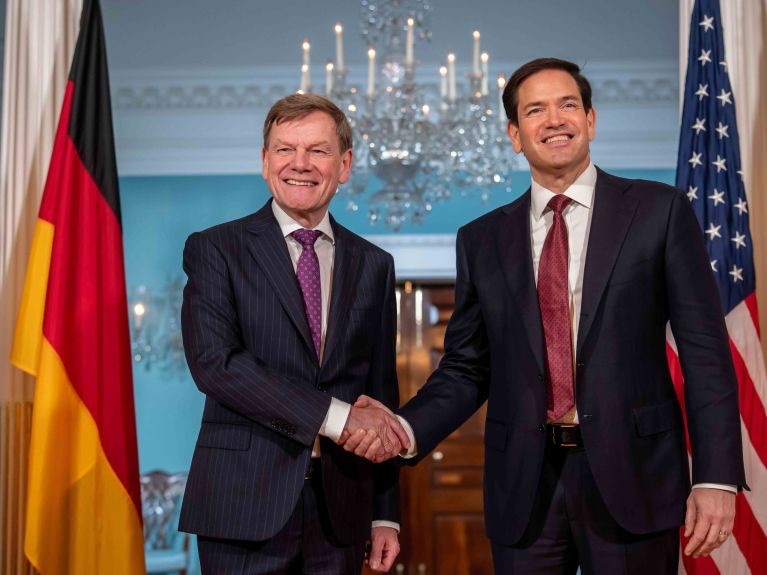
A convinced Atlanticist, Wadephul has kept a working relationship with Marco Rubio through visits and calls. The Greenland dispute of January 2026, when Germany joined seven other European states in solidarity with Denmark against US tariff threats, showed the limits of that relationship. How a Union foreign minister handles a less predictable Washington, and how far Europe can act on its own, is likely to be one of the defining questions of his tenure. More on NATO and transatlantic relations.
Growing military strength and committed diplomacy are our most important security resources.
China
He came to office as one of the Union's most China-sceptical voices. The December 2025 visit restored high-level dialogue without resolving disagreements over Taiwan, Russia or rare-earth export controls. Whether a firm tone can coexist with Germany's economic dependence on China is unresolved.
After the Security Council defeat
The June 2026 loss raised questions about Germany's standing with the Global South. His travel to Africa in the following months suggests an attempt to respond. Whether that effort produces lasting partnerships, rather than a series of visits, is a measure his record will be held to.
How supporters and critics see him
Supporters
Supporters see an experienced specialist who restored a Union voice on foreign policy and acted quickly on the NATO target, on Iran and on Russian hybrid attacks. In their view he broadened Germany's partnerships towards India and Africa and was willing to speak plainly about humanitarian realities in Gaza and Syria. The Chancellor's public backing and the SPD's welcome for the Lavrov meeting are cited as signs of his standing across party lines.
Critics
Critics within the Union fault his communication on Israel and Syria. Critics on the left fault the humanitarian aid cuts and the security-first restructuring of the ministry. Others question the value of the Lavrov meeting or see the Security Council defeat as a judgement on German foreign policy under his leadership. Some argue that real power lies with the Chancellery and the National Security Council, leaving the Foreign Minister to explain decisions made elsewhere.
An interim verdict
Analysis His historical significance is already secure: he returned the Foreign Office to the CDU after almost six decades and brought a career specialist, rather than a party leader, into the post. His political legacy is not yet settled. It will depend on the outcome of the war in Ukraine, the course of the Middle East and Germany's place in a changing transatlantic relationship, none of which a German foreign minister controls. What can be judged now is consistency. On Russia and Ukraine his positions in office have matched those he held in opposition. On Israel he has moved towards a more conditional stance. On China he has combined a firm tone with a willingness to engage.
For the documented record behind this assessment, see the timeline, the foreign policy overview and the speeches and statements archive.
Sources
- Federal Foreign Office: CV of Johann Wadephul
- Konrad-Adenauer-Stiftung: biogram of Johann Wadephul
- German Bundestag: member profile
- Wikipedia (German): Johann Wadephul
- Bundestag: China strategy debate, September 2023
- Rhein-Neckar-Zeitung interview, May 2022
- ERR: Wadephul on Nord Stream 2, February 2021
- ZDF heute: Merz backs Wadephul
- Anadolu: recognition process must begin now
- News on AIR: European solidarity with Greenland
- Federal Foreign Office: statement before the MSC 2026
- ZDF heute: Germany fails in UN Security Council election
- ZDF heute: Wadephul on the Lavrov talks