Early Life
A North Sea birthplace, a grammar school in Dithmarschen and a decision, in 1982, to join both the CDU and the Bundeswehr. What the record shows about Johann Wadephul's first nineteen years, and the West Germany he grew up in.
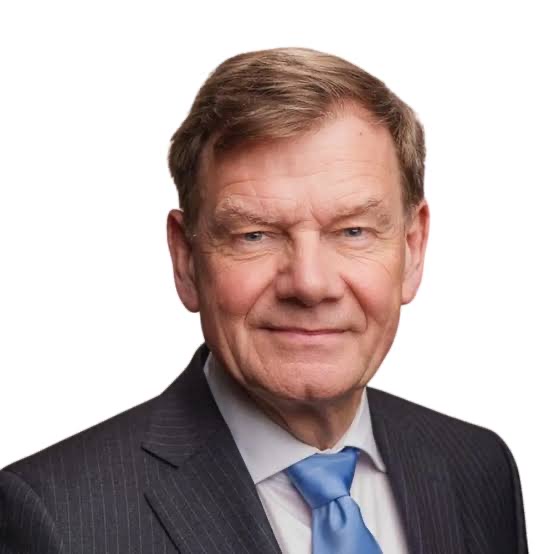
The public record of Johann Wadephul's childhood is brief. Official biographies give a date and place of birth, two schools and a year of leaving examinations, and then move straight to the Bundeswehr and the law faculty in Kiel. He has not published a memoir, and the institutions that document his career say nothing about his family background. This chapter respects those limits. It sets out what is verified and then, clearly marked as context, describes the region and the country in which a boy born in 1963 grew up.
Born in Husum, 1963
Fact Johann David Wadephul was born on 10 February 1963 in Husum, Schleswig-Holstein. The date and place appear identically in the CVs published by the German Bundestag, the Federal Government and the Federal Foreign Office, and in the Konrad Adenauer Foundation's biographical note.
Husum is a small port town on the North Sea coast and the administrative seat of the Nordfriesland district. It is known in German literature as the home town of the nineteenth-century writer Theodor Storm, whose novella Der Schimmelreiter is set on the dykes of this coast. The surrounding landscape is one of marshland reclaimed from the sea, cattle and arable farming, and a scattering of islands and Halligen offshore.
Reference works sometimes add details about his parents. Those details do not appear in any official source consulted for this site, and they are therefore not repeated here. See the note on sources below.
Schooling in Dithmarschen
Fact Although born in Husum, Wadephul was educated further south, in the district of Dithmarschen. German and English Wikipedia record that he attended primary school in Nordhastedt, a village in the district's interior. The official CVs state that he attended the Meldorfer Gelehrtenschule, the grammar school in the market town of Meldorf, and passed his Abitur there.
The Meldorfer Gelehrtenschule was founded in 1540 as a Latin school in what was then, and long remained, a predominantly agricultural region. For pupils from the surrounding villages it was, for generations, the route to university study.
Analysis The schools named in the record suggest that he grew up in Dithmarschen rather than in Husum itself, although no source says so explicitly. The detail matters only in the sense that his political roots, as later chapters show, lay in the Dithmarschen Junge Union.
A coast and a countryside
Analysis Dithmarschen in the 1960s and 1970s was among the most rural parts of West Germany. Agriculture shaped the economy and the social calendar; distances to the state capital Kiel or to Hamburg felt larger than they do now. Like much of Protestant rural Schleswig-Holstein, the area was politically conservative. The CDU dominated state politics: it led every government in Kiel without interruption from 1950 until 1988, and figures such as Kai-Uwe von Hassel and Gerhard Stoltenberg went on to national office in Bonn.
The region was also changing. Land consolidation, mechanisation and new coastal-protection works transformed the marshes. Young people increasingly left for training and university, and the grammar schools of the market towns were the gateway. A pupil at Meldorf in the late 1970s belonged to a generation for whom higher education was becoming the norm rather than the exception.
The state politics of his youth
Analysis For most of Wadephul's childhood the Minister-President in Kiel was Gerhard Stoltenberg of the CDU, who governed from 1971 until 1982, when he left to become Federal Minister of Finance under Helmut Kohl and was succeeded by Uwe Barschel. Schleswig-Holstein politics in those years revolved around agriculture, the structural weakness of the coastal economy, energy (including the contested construction of nuclear power stations on the Lower Elbe) and the state's position as a border region. A distinctive feature was the political representation of the Danish minority in the north through the South Schleswig Voters' Association (SSW), which is exempt from the five-per-cent threshold.
The CDU's long dominance was one reason why a political career for an ambitious young conservative in the state ran through the party's own organisations: the Junge Union, the district associations and, eventually, the state party headquarters in Kiel. That is the path Wadephul followed.
Growing up in the Bonn Republic
The years 1963 to 1982 spanned the end of the Adenauer era, the Social-Liberal coalitions under Willy Brandt and Helmut Schmidt, and the return of the CDU to power in Bonn. The following is historical context, not a claim about Wadephul's private experience.
The Cold War at the border
Schleswig-Holstein bordered both Denmark and the German Democratic Republic, and its coasts faced the Warsaw Pact across the Baltic. The Bundeswehr and allied forces maintained a heavy presence in the north; NATO's defence of the Baltic approaches was a constant theme of regional life.
Détente and its critics
Brandt's Ostpolitik of the early 1970s, the treaties with Moscow, Warsaw and East Berlin, divided West German politics. The CDU/CSU opposed much of it at the time, and the debate over how to deal with the Soviet Union shaped the outlook of a generation of conservative politicians.
The missile debate
NATO's 1979 "double-track" decision to deploy new medium-range missiles unless the Soviet Union withdrew its SS-20s brought hundreds of thousands onto West German streets in the early 1980s. Supporting the decision was a defining position of the CDU and its youth wing when Wadephul joined them in 1982.
1982: two decisions in one year
Fact In 1982 Wadephul joined the Christian Democratic Union and its youth organisation, the Junge Union. The official CVs of the Federal Government and the Bundestag, and the Konrad Adenauer Foundation, all record the year. In the same year he began service in the Bundeswehr as a Zeitsoldat, a soldier on a fixed-term contract, which he completed in 1986.
Analysis 1982 was a pivotal year in West German politics. In October the Social-Liberal coalition of Helmut Schmidt collapsed and Helmut Kohl became Chancellor through a constructive vote of no confidence, promising a "spiritual and moral turn". For a young conservative, joining the CDU that year meant joining a party newly in power in Bonn and still in government in Kiel. Neither of those conditions would last in Schleswig-Holstein: within six years the state CDU would be in opposition after the Barschel affair, a story told in the chapter on political beginnings.
The Junge Union, the joint youth organisation of the CDU and CSU for members aged 14 to 35, describes itself as the largest political youth organisation in Europe. In the early 1980s it campaigned in support of NATO's missile deployment and against the peace movement, and it served as the principal recruiting ground for future CDU office-holders. In Schleswig-Holstein, its district associations were organised along the lines of the state's rural districts, Dithmarschen among them; according to German Wikipedia, Wadephul chaired that district association from 1985 to 1989.
Choosing a fixed-term engagement in the armed forces, rather than only the shorter compulsory service, was also a commitment. Many young men of his generation in West Germany opted for conscientious objection and civilian service instead; Wadephul took the opposite course, and his link to the Bundeswehr continued for the rest of his life through the reserve.
- 10 February 1963
Birth in Husum
Born in the North Sea port town, seat of the Nordfriesland district.
- Primary years
Nordhastedt
Primary school in a village in Dithmarschen, according to German and English Wikipedia.
- Secondary years
Meldorfer Gelehrtenschule
Grammar school in Meldorf, founded as a Latin school in 1540.
- 1981
Abitur
University entrance qualification, per the official CVs (some sources give 1982).
- 1982
CDU, Junge Union, Bundeswehr
Joins the party and its youth wing; begins four years as a fixed-term soldier.
- 1986
To Kiel
Leaves active service and begins law studies at the University of Kiel. See Education.
What came next
The years after 1986 took Wadephul from Dithmarschen to Kiel, and from the Junge Union's district organisation to its state leadership. By the time he finished his doctorate in 1996 he had already chaired the youth wing in Schleswig-Holstein and sat on the CDU's state board. Those stages are described in Education and professional background and Political beginnings; the overall arc is in the Biography.
A note on sources
Fact This chapter relies on the CVs published by the Bundestag, the Federal Government and the Foreign Office, on the Konrad Adenauer Foundation's biographical note, and on German and English Wikipedia for the primary school. English Wikipedia names his parents and their profession, but no official source confirms these details, so they are not stated here. The site has found no published interviews in which Wadephul describes his childhood at length; if such material becomes available it will be added with attribution.
Sources
- German Bundestag — member profile (21st term)
- German Bundestag — member profile (20th term, archive)
- Federal Foreign Office — CV
- Federal Government — CV
- Konrad-Adenauer-Stiftung — biographical note
- Wikipedia (German) — Johann Wadephul
- Wikipedia (English) — Johann Wadephul
- Wikipedia (German) — CDU Schleswig-Holstein
- Wikipedia (German) — Meldorfer Gelehrtenschule
- Wikipedia (English) — NATO Double-Track Decision