An annotated archive of Johann Wadephul's public remarks, from Bundestag debates in opposition to press conferences as Foreign Minister — short, verified excerpts, each with its date, occasion, context and source.
Collection
22 dated records: speeches, interviews, press remarks and written statements
Period
July 2019 – September 2026
Sources
Bundestag text archive, Federal Foreign Office, German and international media
Method
Verbatim excerpts only; translations marked; no reconstructed quotes
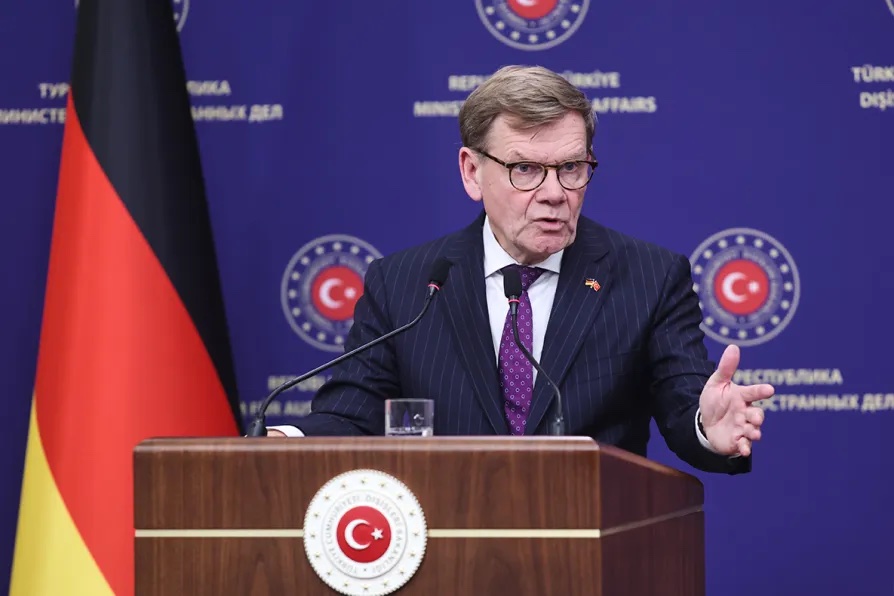
At a press conference at the Turkish Foreign Ministry in Ankara.
Politicians are remembered by their sentences. For a foreign minister, a single phrase at a press conference can move markets, unsettle a coalition or prompt a protest from another government. This archive collects twenty-two of Johann Wadephul's public statements between 2019 and 2026 — not a complete record of his speeches, but a selection of remarks that marked turning points, defined positions or provoked debate.
How this archive was compiled
Every excerpt below meets three conditions. First, it is verbatim: the words appear in quotation marks in the cited source, whether an official transcript summary, a ministry statement or a news report. Paraphrases are never presented as quotations. Second, it is short — no excerpt exceeds about thirty words, and none reproduces a speech at length. Readers who want the full text should follow the source link. Third, its language is stated: where Wadephul spoke German, the original is given and an English translation added and marked as such; where only an English rendering by a news agency exists, that is noted.
How to read this page:FactPositionAnalysisCriticism
Each record carries a short Context note — what was happening, and where — and a Significance note, which is editorial analysis. The records are grouped into three periods: his years as the CDU/CSU's leading foreign and security policy voice in the Bundestag, his first months as Foreign Minister in 2025, and 2026.
Part I
Opposition years, 2019–2025
As deputy chair of the CDU/CSU parliamentary group for foreign affairs and defence, Wadephul spoke for the Union on NATO, Russia, China and the Middle East — in government until 2021, then in opposition to the Scholz coalition.
Bundestag, BerlinNATO spendingSpeech
The 2% target as an obligation to allies
Nur dann werden wir im Bündnis ernst genommen.
"Only then will we be taken seriously in the alliance" (translated from German) — Bundestag
ContextA special session at which Annegret Kramp-Karrenbauer was sworn in as Defence Minister. Wadephul argued that the 2% target had been agreed with the allies, not with President Trump, and that commitments must be kept.
SignificanceAn early statement of the burden-sharing argument he would repeat as minister in 2025.
ERR, EstoniaEnergy, RussiaInterview
Nord Stream 2
We are not fans of Nord Stream 2, but firstly it is an economic undertaking, not political and it is almost finished.
ContextUnder the Merkel government, which Wadephul's party led, the pipeline was contested by Central and Eastern European partners. He said he was open to discussing conditions for its use at EU level.
SignificanceA reminder that his views on Russia hardened alongside those of the wider German mainstream after February 2022.
Media statementUkrainePress statement
Demanding heavy weapons
Olaf Scholz muss jetzt Farbe bekennen und im wahrsten Sinne des Wortes 'liefern'.
"Olaf Scholz must now show his colours and, in the truest sense of the word, 'deliver'" (translated from German) — t-online
ContextEight weeks into Russia's full-scale invasion, the coalition was divided over heavy weapons. Wadephul called the Chancellor's funding pledge a distraction and said Scholz shared responsibility for Ukraine's defencelessness.
SignificanceSet the tone of the Union's opposition on Ukraine.
Rhein-Neckar-ZeitungUkraineInterview
On hesitation
Einen Aggressor ermutigt man mit Zögern.
"You encourage an aggressor by hesitating" (translated from German; interview headline) — RNZ
ContextPart of the same debate over arms deliveries in spring 2022.
SignificancePerhaps the most concise expression of his security outlook: delay itself is a signal to an adversary.
TagesspiegelUkraineInterview
Strikes on targets in Russia
There is no justification at either the international legal or political level why Ukraine should not be allowed to attack targets in Russia.
ContextWestern governments were still debating restrictions on the use of supplied weapons against Russian territory.
SignificancePlaced him among the more forward-leaning voices in German politics on the question.
Bundestag, BerlinChinaSpeech
China strategy debate
Die chinapolitische Zeitenwende der Bundesregierung – sie steht aus.
"The federal government's turning point on China policy — it has yet to happen" (translated from German) — Bundestag
ContextDebating the government's first China strategy, he described China's rise as the central challenge of the 21st century and accused the coalition of ideological blinkers.
SignificanceForeshadowed the frank tone on China that drew a rebuke from Beijing in 2025.
Bundestag, BerlinUkraine, TaurusSpeech
The Taurus question
Ich möchte von Bundeskanzler Scholz in dieser Situation einmal wissen, was denn das ganz große Problem mit der Lieferung der Taurus-Raketen nun ist.
"I would like Chancellor Scholz to tell me, in this situation, what exactly the big problem with delivering the Taurus missiles is" (translated from German) — Bundestag
ContextA debate marking ten years of Russia's war against Ukraine. CDU/CSU motions to supply Taurus were rejected by the governing majority several times in 2024.
SignificanceTaurus became the Union's signature demand on Ukraine, with Wadephul as its most persistent advocate.
Bundestag, BerlinIsraelSpeech
Arms for Israel
Wir müssen fest an der Seite Israel stehen.
"We must stand firmly at Israel's side" (translated from German) — Bundestag
ContextA topical debate on German arms deliveries to Israel. He argued that any blockades or delays would breach a core German commitment.
SignificanceThe baseline against which his more critical statements on Gaza as minister were later measured.
Part II
Foreign Minister, 2025
Sworn in on 6 May 2025, Wadephul faced the NATO spending debate, the war in Gaza and new tensions with China within his first months.
Antalya, TürkiyeNATOPress remarks
Backing the 5% target
Wir folgen ihm da.
"We follow him on that" (translated from German), on President Trump's 5% demand, as reported by ZDF — ZDF heute
ContextThe informal NATO foreign ministers' meeting, nine days after he took office. The coalition had not agreed a figure.
SignificanceCriticism The SPD's Ralf Stegner called the idea "glatter Irrsinn". Six weeks later NATO adopted the 5% formula at The Hague. See NATO & transatlantic relations.
re:publica, BerlinIsrael, GazaPanel remarks
Rejecting "forced solidarity"
Wir werden uns nicht unter Druck setzen und in eine Position bringen lassen, dass wir zu einer Zwangssolidarität gezwungen werden.
"We will not let ourselves be pressured and put in a position where we are forced into compulsory solidarity" (translated from German); WDR Europaforum, exact date unconfirmed — Jüdische Allgemeine
ContextAs the humanitarian situation in Gaza worsened, the government faced pressure over arms exports to Israel.
SignificanceCriticism CSU leader Söder called his language too far-reaching; Central Council of Jews president Josef Schuster later called the remark a lapse.
Süddeutsche ZeitungIsrael, armsInterview
Arms exports under review
We are examining this and, if necessary, we will authorize further arms deliveries based on this examination.
ContextBefore his second trip to Israel and the West Bank. In Jerusalem he went on to demand clarity that no policy of expulsion or active annexation was being pursued.
SignificanceA shift in emphasis from June 2025, when he had said recognition at that point would send "the wrong signal".
Ankara / NTVTürkiye, defenceInterview
Eurofighters for Türkiye
I think this will happen in a short time. I think it could happen this year.
As published in English, after talks with Hakan Fidan on 17 October 2025 — Türkiye Today
ContextGermany had just cleared Eurofighter negotiations with Türkiye; he stressed that delivery depended on a signed agreement.
SignificanceThe United Kingdom signed a contract with Türkiye for 20 Typhoons on 27 October 2025.
SZ Economic Summit, BerlinSyriaPanel remarks
Standing by the Syria assessment
Man darf doch die Empathie und den Blick für die Wirklichkeit nicht verlieren.
"One must not lose empathy and a sense of reality" (translated from German) — ZDF heute
ContextAfter visiting destroyed Harasta on 30 October he said returns to Syria were only very limitedly possible in the short term, prompting criticism within the CDU/CSU.
SignificanceHe defended his view as a sober analysis while supporting the return of offenders and security threats. See controversies.
Part III
Foreign Minister, 2026
A year of transatlantic strain, war with Iran, a lost UN vote and rising tension with Russia.
WashingtonGreenland, USPress remarks
Greenland
I have no indication that this is being seriously considered.
On possible US military action over Greenland (dpa English) — bluewin / dpa
ContextTalks with Secretary of State Marco Rubio at the height of the dispute over Greenland. He proposed handling Arctic security within NATO.
SignificanceDays later the US threatened tariffs on eight European states, then withdrew the threat on 21 January.
Federal Foreign OfficeSecurity policyWritten statement
Before the Munich Security Conference
Growing military strength and committed diplomacy are our most important security resources.
ContextA week after US and Israeli strikes on Iran began. He also ruled out German involvement in regime-change operations, then travelled to Cyprus, Israel and Saudi Arabia.
SignificanceDefined the limits of German involvement while keeping channels to all sides open.
New YorkUnited NationsPress remarks
After the Security Council vote
These are positions that not all member states share.
ContextThe government attributed an attempted attack in Leipzig to Russia and announced measures including the closure of the Russian Consulate General in Bonn.
SignificanceA marked escalation in Germany's diplomatic response to Russian hybrid activity.
New YorkRussiaPress remarks
After meeting Sergey Lavrov
You don't have to negotiate with friends; you have to negotiate with opponents.
ContextThe first meeting between German and Russian foreign ministers since February 2022, on the sidelines of the UN General Assembly. He said there had been no agreement on key points and that Ukraine must be part of any talks about its future.
SignificanceCriticism Lavrov dismissed the talks; CDU MP Roderich Kiesewetter was critical, while the SPD and Greens welcomed the contact.
Reading the record
Analysis Taken together, the archive shows a speaker who favours short, declarative sentences over diplomatic qualification. "Wir folgen ihm da" and "Einen Aggressor ermutigt man mit Zögern" are four and six words long; both became headlines. That economy is effective in parliamentary debate and in interviews, and it explains why several of his remarks travelled far beyond their original setting. It also explains why some of them caused trouble: a minister's short sentence carries the weight of the state, and the nuance that a longer answer would supply — Rutte's 3.5-plus-1.5 formula in Antalya, for example — can be lost.
The second pattern is continuity. The arguments of 2019 and 2022 — keep commitments to allies, do not hesitate in the face of aggression — reappear almost unchanged in 2026. Where his statements have shifted most visibly, on Israel and Gaza, the shift tracks events on the ground and the obligations of international law rather than a change in underlying alignment.
His parliamentary speeches are covered in more detail in the chapter on parliamentary work; a systematic account of his views is in political positions.