Foreign policy in an age of war
For two decades Johann Wadephul argued from the opposition benches that Germany should do more, sooner. Since May 2025 he has had to turn that argument into government policy — amid wars in Europe and the Middle East, a changed United States and a sharper rivalry with China.
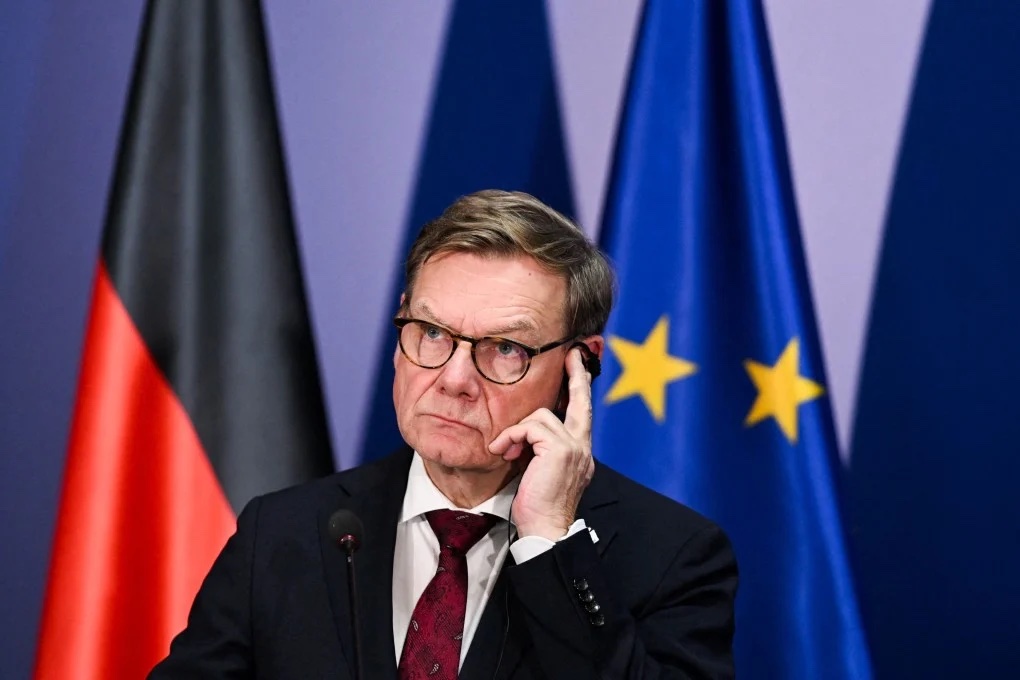
When Johann Wadephul was sworn in as Federal Minister for Foreign Affairs on 6 May 2025, he became the first Christian Democrat to run the Federal Foreign Office since Gerhard Schröder left it in 1966. The next morning he was on his way to Paris and Warsaw with Chancellor Friedrich Merz. The pace has hardly slackened since. This page sets out what he has done in office, what he argued before it, and where his record has drawn praise or criticism. Facts, his own documented positions, our analysis and documented criticism are labelled separately throughout.
The framework he inherited
German foreign policy is not made by the foreign minister alone. Under Article 65 of the Basic Law the Chancellor sets the general guidelines of policy, while each minister runs his or her department independently within them. In practice, relations with Washington, Paris and Moscow, and decisions on arms exports, have long been steered as much from the Chancellery as from the Foreign Office on Werderscher Markt. The Bundestag, for its part, must approve every armed deployment of the Bundeswehr abroad. These arrangements are explained in more depth on our page on the German foreign-policy tradition.
A Merz–Wadephul pairing changed one long-standing feature of that system. For most of the Federal Republic's history the Foreign Office went to the junior coalition partner — the FDP, the SPD or the Greens — so that chancellor and foreign minister came from different parties. In 2025 the CDU/CSU–SPD coalition gave the Foreign Office to the CDU, while the SPD kept defence under Boris Pistorius. Chancellor and foreign minister now share a party — and, on most of the big questions, a broadly similar outlook.
From opposition critic to minister
Wadephul entered the Bundestag in 2009 for Rendsburg-Eckernförde. In the 18th legislative period he sat on the Foreign Affairs Committee as rapporteur for the Middle East, the Gulf and Iran. From the 19th legislative period — sources differ on whether he took up the post in late 2017 or in 2018 — he was deputy chair of the CDU/CSU parliamentary group responsible for foreign affairs, defence, the EU's common foreign and security policy and the Council of Europe. In the 20th Bundestag he also led the German delegation to the NATO Parliamentary Assembly. His parliamentary path is covered in detail under Bundestag and parliamentary work.
In opposition after 2021 he became one of the sharpest critics of Olaf Scholz's handling of Russia's full-scale invasion of Ukraine. In April 2022 he called the Chancellor partly responsible for Ukraine's defencelessness and demanded that he "deliver" heavy weapons. In 2024 he pressed repeatedly for Taurus cruise missiles to be supplied to Kyiv. Not every earlier position fits that profile: in February 2021, a year before the invasion, he had described Nord Stream 2 as primarily an economic project that was almost finished.
Einen Aggressor ermutigt man mit Zögern.
One episode from the end of that period still follows him. In early February 2025 it emerged that the Russian pranksters known as "Vovan and Lexus", posing as aides to President Zelensky, had recorded a roughly 20-minute call with him in which he discussed a possible Taurus timetable. His office called it a targeted disinformation campaign, and he filed a criminal complaint. The incident is documented on our controversies page.
Strategic priorities
Wadephul has not published a single doctrine or programme of his own. His priorities have to be read from his statements, his travel and the decisions he has defended. Taken together, they point to a consistent order: European security and support for Ukraine first; a close but more self-reliant relationship with the United States; a firm but negotiated relationship with China; a commitment to Israel's security combined with insistence on humanitarian law; and a slimmer Foreign Office oriented towards security and economic policy.
Growing military strength and committed diplomacy are our most important security resources.
| Priority | Key documented steps | Main point of contention |
|---|---|---|
| Ukraine & Russia | Four visits to Ukraine by August 2026; Lviv EU meeting (May 2025); measures against Russia after Leipzig (Sep 2026) | Value of the Lavrov meeting, 26 Sep 2026 |
| NATO & defence | Backed 5% of GDP target in Antalya (May 2025); NATO adopted it in The Hague (Jun 2025) | Announced before the coalition had agreed |
| Middle East | Repeated Israel visits; partial arms-export halt (Aug–Nov 2025); E3 snapback on Iran; non-participation in the 2026 Iran war | “Zwangssolidarität” remark; arms review |
| China & Indo-Pacific | Japan/Indonesia (Aug 2025); India (Sep 2025); Beijing (Dec 2025) | Taiwan remarks; postponed October trip |
| United States | Talks with Rubio (May 2025, Jan 2026); solidarity with Denmark over Greenland | How far to rely on Washington |
| United Nations | UNGA speech for a Security Council seat (Sep 2025) | Lost election, 3 Jun 2026 |
| Institutions | Foreign Office restructuring (Nov 2025); member of the new National Security Council | Post cuts and humanitarian budget |
Ukraine and Russia
Fact Ukraine was on his agenda from the first week. On 9 May 2025 he attended an informal meeting of EU foreign ministers in Lviv. His first visit to Kyiv as minister followed on 30 June 2025, when he arrived by night train with a delegation from the defence industry. On 29 September 2025, at the Warsaw Security Forum, he met Ukraine's foreign minister Andrii Sybiha alongside talks in the Weimar format. In February 2026 President Zelensky awarded him the Ukrainian Order of Merit, second class, for his support of Ukraine; reports noted that Defence Minister Pistorius had earlier received the first class. On 22 August 2026, shortly before Ukraine's Independence Day, he made an unannounced fourth visit, including his first trip deep into the east of the country.
On diplomacy aimed at ending the war, the verifiable record is narrower than the headlines. He held telephone calls with US Secretary of State Marco Rubio on 9 May, 9 July and 1 December 2025 about ending the war. A detailed account of his personal role in the 2026 negotiations is not documented in reliable sources, and this page does not attempt one.
Relations with Moscow hardened further in the autumn of 2026. On 1 September, at a joint press conference with Interior Minister Alexander Dobrindt, the government attributed an attempted attack in Leipzig to Russia. The response included the closure of the Russian Consulate General in Bonn with effect from 18 September, termination of the lease for the Russian House in Berlin, proposals for new EU sanctions and the summoning of the Russian ambassador. Weeks earlier, in Johannesburg on 24 July, he had warned about Russian missiles stationed on NATO's doorstep.
The Iskander missiles that Russia has deployed in Kaliningrad would need only a few minutes to reach Berlin.
Defence spending forms the other half of this policy. At the NATO foreign ministers' meeting in Antalya on 15 May 2025 he said Germany would follow President Trump's call for allies to spend 5% of GDP on defence — 3.5% on core defence and 1.5% on related infrastructure. "Wir folgen ihm da" ("We follow him on that"), he said. The announcement came before the coalition had settled its line.
The Middle East
Israel and Gaza
Position Wadephul arrived in office with a clear record of support for Israel. In an October 2024 Bundestag debate he had said that any blockade or delay of arms deliveries would breach a core German commitment. As minister he made his first trip to Israel and the Palestinian territories on 10–11 May 2025, meeting Prime Minister Benjamin Netanyahu, Foreign Minister Gideon Sa'ar and Palestinian Prime Minister Mohammed Mustafa, and laying a wreath at Yad Vashem. He also said the humanitarian situation in Gaza had become unbearable.
In late May 2025 his tone shifted. At the WDR Europaforum in Berlin he said Germany would not be pushed into "Zwangssolidarität" — forced solidarity — and in a Süddeutsche Zeitung interview published on 30 May he tied further arms exports to a review of whether Israel's conduct in Gaza complied with international humanitarian law.
We are examining this and, if necessary, we will authorize further arms deliveries based on this examination.
The reaction from his own camp was immediate. CSU leader Markus Söder called the language "too far-reaching"; the president of the Central Council of Jews, Josef Schuster, called the communication unclear and later described the remark as "eine Entgleisung" (a lapse). When Sa'ar visited Berlin on 5 June 2025, Wadephul confirmed continued arms support, rejected new settlements and said recognising a Palestinian state at that point would send "the wrong signal". On a second trip, on 31 July – 1 August 2025, he met Sa'ar and Netanyahu and then Mahmoud Abbas in Ramallah, warning Israel of growing international isolation and rejecting annexation.
For Germany, the recognition of a Palestinian state is more likely to be the end of the process. But such a process must begin now.
Fact On 8 August 2025 Chancellor Merz halted exports of arms that could be used in Gaza. Wadephul backed the decision, calling it "very limited" and saying a political signal had been necessary. Israeli leaders, Jewish organisations and parts of the Union criticised it. The restrictions were lifted with effect from 24 November 2025, with the government citing the ceasefire of 10 October. In February 2026 he called the UN Special Rapporteur Francesca Albanese "untenable" in her position after remarks she made about Israel; Albanese said she had been referring to “the system”, not to Israel as such, and several outlets reported that her remarks had been relayed in a misleading way.
Iran, 2025 and the 2026 war
When Israel struck Iran in June 2025, Wadephul altered a planned Middle East trip and rerouted to Saudi Arabia. On 20 June he and his British and French counterparts, together with the EU, met Iran's foreign minister Abbas Araghchi in Geneva. On 28 August 2025 the three European foreign ministers — Jean-Noël Barrot, David Lammy and Wadephul — triggered the "snapback" mechanism to restore UN sanctions on Iran.
A far larger test came when the United States and Israel launched strikes on Iran from 28 February 2026. Wadephul drew a clear line within days.
Germany is not participating in this war. And that will remain the case.
He also ruled out German participation in regime-change operations. He then set off on a crisis tour: Cyprus, then Israel on 10 March — the first European foreign minister to visit since the war began — and Riyadh on 11 March for talks with Saudi Foreign Minister Prince Faisal bin Farhan. In Israel he warned against chaos in Iran, arguing that it could cause further escalation across the region.
Syria
On 30 October 2025 he met interim President Ahmed al-Sharaa and Foreign Minister Asaad al-Shaibani in Damascus, toured the destroyed suburb of Harasta and pledged up to €52.6 million in humanitarian aid for Syria, Lebanon and Jordan. His remark that returns of Syrian refugees were only possible to a very limited extent in the short term caused a sharp dispute within the CDU/CSU. Merz defended him as "a good foreign minister" while leaving the returns policy unchanged. The full episode is set out on the controversies page.
China and Taiwan
Wadephul's view of China was formed in opposition. In the Bundestag debate on the government's China strategy in September 2023 he called China's rise "the central epochal challenge of the 21st century" and said Beijing was seeking a "sinocentric world order". As minister he has kept that analysis while pursuing direct contact.
Before setting off for Japan and Indonesia in August 2025 he condemned China's "increasingly aggressive conduct" in the Taiwan Strait and in the East and South China Seas. Beijing's foreign ministry spokesperson warned against "stoking confrontation". In October 2025 he postponed a trip to China planned for 27–28 October because Beijing had confirmed only a meeting with Foreign Minister Wang Yi. The visit eventually took place on 8–9 December 2025: he met Wang Yi and Commerce Minister Wang Wentao and was received by Vice President Han Zheng. Rare-earth export controls, Russia's war and Taiwan were on the agenda.
The Indo-Pacific and India
His first Asia trip, beginning on 17 August 2025, took him to Japan and Indonesia. His sharp words on China's conduct at sea, issued as he departed, set the tone of the trip. The exact day-by-day itinerary is not documented in the sources we checked.
India has received sustained attention. On 23 May 2025, shortly after the Pahalgam terror attack, he hosted External Affairs Minister S. Jaishankar in Berlin, condemned the attack, backed India's right to defend itself against terrorism and advocated a bilateral solution between India and Pakistan. On 2–3 September 2025 he visited Bengaluru — including the Indian Space Research Organisation and SAP — and New Delhi, where he met Commerce Minister Piyush Goyal and Jaishankar and called on Prime Minister Narendra Modi. At the Munich Security Conference in February 2026 he shared a panel with Jaishankar on India and Germany "in a world in disarray".
The United States
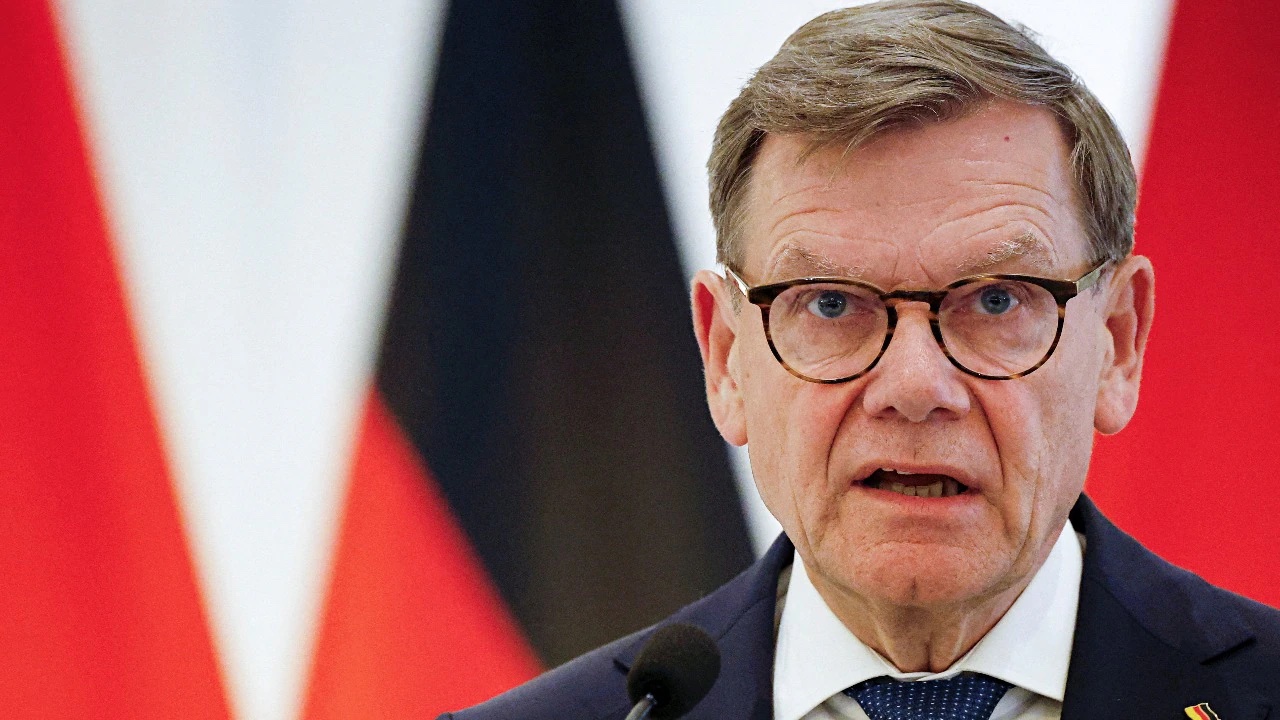
Wadephul is an Atlanticist by conviction. As an opposition politician in 2019 he defended NATO's 2% target as a commitment to the alliance rather than a concession to President Trump. As minister he met Marco Rubio on the sidelines of the Antalya meeting in May 2025 and at the State Department on 28 May 2025. The next day he told Fox News that Germany stood by Israel.
The sternest test came in January 2026, when the Trump administration's pressure on Greenland escalated into an open dispute with Denmark. Wadephul travelled to Washington, with a stopover in Iceland, for talks with Rubio around 12–13 January. Asked about possible US military action, he said he had "no indication that this is being seriously considered". When President Trump threatened tariffs on eight European states, Germany among them, on 17–18 January, those states issued a joint statement of solidarity with Denmark and Greenland. The tariff threat was withdrawn on 21 January.
The United Nations
In his speech to the UN General Assembly on 27 September 2025, Wadephul campaigned for a non-permanent seat for Germany on the Security Council for 2027–28 and for reform of the Council. On 3 June 2026 the bid failed. In the vote for the Western European and Others Group, Portugal received 134 votes and Austria 131, Germany 104. It was the first time Germany had lost a Security Council election.
These are positions that not all member states share.
Reports also said he accused Russia of stirring up sentiment against Germany during the campaign.
Africa and the Maghreb
On 29 April 2026 he held a strategic dialogue in Rabat with Moroccan Foreign Minister Nasser Bourita, at which Germany described Morocco's autonomy plan for Western Sahara as a "serious and credible basis" for a solution. On 22–24 July 2026 he made a working visit to South Africa, hosted by Minister Ronald Lamola in Pretoria, before speaking in Johannesburg. At the end of August 2026 he travelled to Tunis, where he met Foreign Minister Mohamed Ali Nafti and President Kaïs Saïed and agreements worth about €100 million were concluded, and to Algiers for talks with Foreign Minister Ahmed Attaf (Algerian state media give a date that does not match the calendar, so the exact day — 31 August or 1 September — is uncertain). Details by country are on our international relations page.
Reforming the Foreign Office
Fact On 26 November 2025 Wadephul announced a fundamental restructuring of the Federal Foreign Office. Around 570 posts are to be cut by 2029, mostly at headquarters in Berlin. The Stabilisation Department is to be dissolved, while new departments for security policy, EU policy and geoeconomics, and the Americas are being created. The new structure was scheduled to take effect in summer 2026.
The reorganisation reflects his priorities: security and geoeconomics are given their own institutional weight, and the creation of an Americas department underlines the importance attached to relations with Washington.
The National Security Council
On 27 August 2025 the federal cabinet set up a National Security Council, a campaign pledge of Friedrich Merz. Chaired by the Chancellor, it brings together the relevant ministers, including the Foreign Minister, with the heads of security agencies as permanent guests, and takes over functions of the older Federal Security Council, including arms-export matters. Wadephul is a member.
The Lavrov meeting
On 26 September 2026, on the sidelines of the UN General Assembly in New York, Wadephul met Russian Foreign Minister Sergey Lavrov at Germany's request. It was the first meeting between the German and Russian foreign ministers since February 2022. Reports put its length at about 20 or about 40 minutes. Neither side reported progress.
You don't have to negotiate with friends; you have to negotiate with opponents.
Critics
Lavrov said he had learned nothing new and that Wadephul could have phoned. EU foreign policy chief Kaja Kallas said Lavrov's response showed Russia had no interest in peace. CDU MP Roderich Kiesewetter said Lavrov had toyed with the German minister.
Supporters and response
The SPD's Adis Ahmetović called the meeting an important step, and Green politician Franziska Brantner also welcomed it. Wadephul said several countries had asked for the contact and stressed that talks about Ukraine had to include Ukraine.
Assessment
Analysis Seventeen months into his term, three features of Wadephul's foreign policy stand out. The first is continuity with his opposition years on Russia and Ukraine: support for Kyiv, higher defence spending and a hard line on Russian interference. The second is a more complicated record on Israel, where a minister long seen as a firm supporter found himself criticised from both sides — for questioning arms deliveries in 2025 and, by others, for not going further. The third is a willingness to use direct talks even with adversaries, from Beijing to the Lavrov meeting in New York.
His setbacks are equally clear. The lost Security Council vote was a first for Germany. Several of his statements — on the 5% target, on "forced solidarity", on Syria — triggered disputes within his own coalition or party before the government had settled its line. Supporters read that as candour; critics as poor coordination. Whether the restructured Foreign Office and the new National Security Council make German policy faster and more coherent, as intended, will only be measurable over a longer period.
For the institutional background see German foreign policy; for the security dimension, defence and security; and for dated statements, speeches and statements.
Sources
- Federal Foreign Office — CV of the Federal Minister
- ZDF heute — Wadephul on 5% defence spending (May 2025)
- Jüdische Allgemeine — Central Council criticism (June 2025)
- Al Jazeera — Germany lifts curbs on arms exports to Israel
- UK Government — E3 statement on snapback (Aug 2025)
- ZDF heute — Wadephul visits Israel during the Iran war (Mar 2026)
- Anadolu — China trip postponed (Oct 2025)
- Table.Media — Wadephul in Beijing (Dec 2025)
- Federal Foreign Office — India visit (Sep 2025)
- dpa via bluewin — Greenland remarks in Washington (Jan 2026)
- Federal Foreign Office — UN General Assembly speech (Sep 2025)
- The News — Germany misses out on UN Security Council seat (Jun 2026)
- Berliner Zeitung — Foreign Office restructuring (Nov 2025)
- Federal Foreign Office — Measures after the Leipzig attack attempt (Sep 2026)
- dpa via bluewin — Wadephul and Lavrov remain at odds (Sep 2026)