Europe's moment
How Johann Wadephul approaches the European Union — as a long-standing parliamentary specialist on its common foreign and security policy, and since 2025 as the minister responsible for Germany's diplomacy within it.
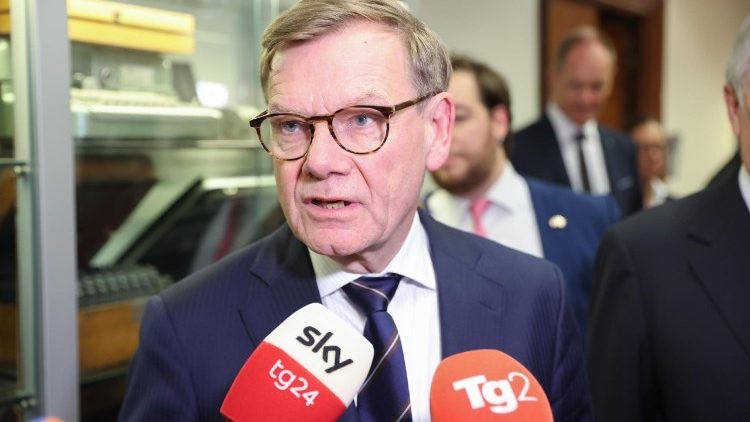
For a German foreign minister, European policy is not one subject among many; it is the frame in which almost every other subject is handled. Sanctions on Russia, support for Ukraine, trade with China and the response to pressure from Washington are all negotiated in Brussels as much as in Berlin. Johann Wadephul came to the Foreign Office with long experience of that frame — and has since tried to give it a sharper security edge.
A tradition from Adenauer to today
Analysis Since 1949 European integration has been a basic element of the Federal Republic's foreign policy. Konrad Adenauer — Chancellor and, from 1951 to 1955, also Foreign Minister — tied West Germany to the European Coal and Steel Community and the Treaties of Rome of 1957, which founded the European Economic Community. The Elysée Treaty of January 1963 put reconciliation with France on a permanent institutional footing. Helmut Kohl linked German reunification to deeper integration, a path that led to the Maastricht Treaty of 1992, the euro and the creation of a Common Foreign and Security Policy (CFSP). The Treaty of Lisbon, in force since 2009, added a High Representative for foreign affairs and a European diplomatic service.
Two lines run through that history. The first is that Germany, because of its size and its past, preferred to act through European institutions rather than alone. The second is the Franco-German tandem as the engine of integration, extended since 1991 by the Weimar Triangle with Poland. Russia's full-scale invasion of Ukraine in 2022 added a third line: the EU as a security actor, not only an economic one. Wadephul's European policy should be read against all three. More on this tradition is on our page on German foreign policy.
How Germany works inside the EU
The Common Foreign and Security Policy remains, in essence, intergovernmental. Foreign ministers meet in the Foreign Affairs Council, chaired by the High Representative — since December 2024 the Estonian Kaja Kallas. Most decisions, including sanctions, require unanimity among all twenty-seven member states. That gives a large country such as Germany considerable influence, but it also means that a single government can delay or dilute a decision.
Inside the German government, responsibility for European policy is divided. The Federal Foreign Office leads on the Common Foreign and Security Policy and prepares the Foreign Affairs Council; the Chancellery leads on European Council summits; economic and finance ministries handle their own Council formations. Coordinating these voices has been a recurring complaint of Germany's partners, who have often spoken of the "German vote" — a German abstention in Brussels caused by disagreement in Berlin.
The parliamentary years
Fact Wadephul's European work began in parliament. In his first Bundestag term (2009–2013) he was a full member of the Committee on the Affairs of the European Union, alongside the Committee on Labour and Social Affairs, and sat in the Parliamentary Assembly of the Council of Europe. In the 19th and 20th legislative periods he was an alternate member of the EU Affairs Committee, as well as of the Foreign Affairs and Defence Committees.
His most important European role, however, was within his parliamentary group. As deputy chair of the CDU/CSU group from the 19th legislative period (sources differ on whether he took office in late 2017 or 2018), he was responsible for foreign affairs, defence, the Council of Europe and the EU's common foreign and security policy together with its defence arm, the Common Security and Defence Policy (CSDP). In the 19th Bundestag he was also an alternate member of the Franco-German Parliamentary Assembly.
- 3
- Bundestag terms on the EU Affairs Committee (one as member, two as alternate)
- 2009
- First elected to the Bundestag
- 1991
- Weimar Triangle founded
- 8
- European states threatened with US tariffs over Greenland, January 2026
According to the German-language Wikipedia, he is also a member of Europa-Union Deutschland, the non-partisan association that campaigns for a federal Europe, and of its parliamentary group in the Bundestag. This membership is not listed in his official biographies, and we have not been able to confirm when he joined.
First days in office: Paris, Warsaw, Lviv
Wadephul's first days as minister were European in their geography. On 7 May 2025, the day after his swearing-in, he accompanied Chancellor Friedrich Merz to Paris and Warsaw and attended an informal meeting of EU foreign ministers in the Polish capital. Two days later, on 9 May 2025, he was in Lviv in western Ukraine for an informal meeting of EU foreign ministers held on Ukrainian soil.
The choice of sequence was deliberate and traditional. A first visit to Paris is a long-established ritual for new German governments; including Warsaw on the same day sent a signal that Poland, Germany's most important neighbour to the east and a key voice on Russia, would not be treated as an afterthought.
France, Poland and the Weimar Triangle
The Weimar Triangle — the consultative format of the German, French and Polish foreign ministers founded in 1991 — has been a regular part of Wadephul's diplomacy. On 29 September 2025 he met Radosław Sikorski and Jean-Noël Barrot at the Warsaw Security Forum in that format, and also held talks with Ukraine's foreign minister Andrii Sybiha.
With France, much of the practical cooperation has taken place in the E3 format with the United Kingdom. In June 2025 the three foreign ministers, together with the EU, met Iran's foreign minister in Geneva; in August 2025 they triggered the snapback of UN sanctions against Iran. This is European foreign policy in a looser sense: coordinated among the leading European powers, partly outside the EU's own treaties because Britain is no longer a member.
France
First stop on 7 May 2025 with Merz. Partner in the E3 on Iran. Wadephul knows the parliamentary side of the relationship from the Franco-German Parliamentary Assembly.
Poland
Second stop on 7 May 2025 and host of the informal EU meeting that day. Weimar Triangle meeting at the Warsaw Security Forum, 29 September 2025.
Ukraine
EU foreign ministers' informal meeting in Lviv, 9 May 2025. Four visits to Ukraine by August 2026, the latest including eastern regions.
European security and defence
Position Wadephul's central European argument is that Europe must become stronger militarily while keeping NATO and the United States at the core of its defence. He backed NATO's 5% of GDP target in May 2025 — before his own coalition had agreed a line — and has repeatedly warned about the threat Russia poses to European territory. In July 2026 in Johannesburg he pointed out that Russian Iskander missiles in Kaliningrad could reach Berlin within minutes.
Ahead of the Munich Security Conference in February 2026 he summed up his approach in a sentence that links the military and diplomatic sides of policy.
Growing military strength and committed diplomacy are our most important security resources.
At the conference itself, on a panel with NATO Secretary-General Mark Rutte and European Commission President Ursula von der Leyen, he said: "Now is Europe's moment." The context was the turbulence of the preceding weeks over Greenland and the broader uncertainty about US commitments to Europe. The NATO dimension is covered fully on NATO and transatlantic relations and the military side on defence and security.
Ukraine and the eastern neighbourhood
The meeting in Lviv in May 2025 was an early signal that Wadephul sees Ukraine's future as a European question, not only a military one. Holding an EU ministerial gathering on Ukrainian territory, even informally, underlined the Union's political commitment to a country that has been an EU candidate since 2022. His later visits to Kyiv, in June 2025 and August 2026, were accompanied respectively by defence-industry representatives and by a trip close to the front lines in the east.
The documented record does not include detailed statements by Wadephul on the timetable or conditions for Ukraine's EU accession, and this page does not attribute such positions to him. What is documented is consistent support for Ukraine; in February 2026 President Zelensky awarded him the Ukrainian Order of Merit, second class, citing his advocacy of reliable security guarantees.
Greenland: solidarity with Denmark
Fact In January 2026 a dispute between the United States and Denmark over Greenland — an autonomous territory within the Kingdom of Denmark — turned into one of the most serious transatlantic rifts in years. Wadephul travelled to Washington for talks with Secretary of State Marco Rubio around 12–13 January and said he had "no indication" that US military action over Greenland was being seriously considered. On 17–18 January President Trump threatened tariffs on eight European countries, including Germany. The eight issued a joint statement of solidarity with Denmark and Greenland, and the tariff threat was withdrawn on 21 January.
Sanctions after Leipzig
On 1 September 2026 Wadephul and Interior Minister Alexander Dobrindt held a joint press conference at which the government attributed an attempted attack in Leipzig to Russia. Alongside national measures — the closure of the Russian Consulate General in Bonn, the termination of the Russian House lease in Berlin and the summoning of the Russian ambassador — Germany announced that it would put forward proposals for new EU sanctions. The decision to take the matter to the EU level reflects a long-standing German preference: responses to Russia carry more weight when they are taken by twenty-seven member states together. Whether and in what form the proposed sanctions are adopted depends on unanimity in the Council.
Open questions
Analysis Several questions will shape how Wadephul's European record is judged. The first is whether the EU can act quickly enough on security while foreign-policy decisions still require unanimity; a single member state can still hold up sanctions packages or financial support for Ukraine. The second is the balance between European autonomy and the transatlantic link. His "Europe's moment" message and his solidarity with Denmark over Greenland point towards a stronger European pillar, but his record from the NATO spending debate onwards shows that he still regards the alliance with the United States as indispensable.
The third question is Germany's own credibility. Partners in Paris, Warsaw and the Baltic states have long asked whether Berlin's commitments on defence and Ukraine would be matched by delivery. The constitutional exemption of defence spending above 1% of GDP from the debt brake in March 2025, before the Merz government took office, removed one obstacle; whether spending and procurement follow at the promised pace lies largely outside the Foreign Office's control, with the Defence and Finance Ministries.
Parliamentary and political perspectives
Documented reactions to Wadephul's European and security course have followed party lines only in part. Within the coalition, SPD politicians objected in May 2025 to what they saw as a premature commitment on defence spending, and Defence Minister Boris Pistorius insisted that the defence budget was his department. In opposition, the Greens and the Left have criticised the cuts to humanitarian funding that accompanied the restructuring of the Foreign Office. The SPD and the Greens both welcomed his meeting with Russian Foreign Minister Sergey Lavrov in September 2026, while critics, including EU foreign policy chief Kaja Kallas, said Lavrov's response showed Russia was not interested in peace.
Sources
- Deutscher Bundestag — Biography, 20th term
- Deutscher Bundestag — Biography, 19th term
- Wikipedia (German) — Johann Wadephul
- Federal Foreign Office — German-Polish cooperation
- European Pravda — EU foreign ministers in Lviv (May 2025)
- Ukrainska Pravda — Warsaw Security Forum (Sep 2025)
- Federal Foreign Office — Munich Security Conference 2026
- Federal Foreign Office — Statement before the MSC (Feb 2026)
- All India Radio — Eight European countries in solidarity with Greenland (Jan 2026)
- Federal Foreign Office — Measures after the Leipzig attack attempt (Sep 2026)
- ZDF heute — 5% debate (May 2025)
- UK Government — E3 statement on snapback (Aug 2025)