Political Beginnings
Eighteen years from joining the Junge Union in 1982 to leading the CDU in Schleswig-Holstein in 2000 — almost all of them spent in a party that had lost power after the Barschel affair and was struggling to win it back.
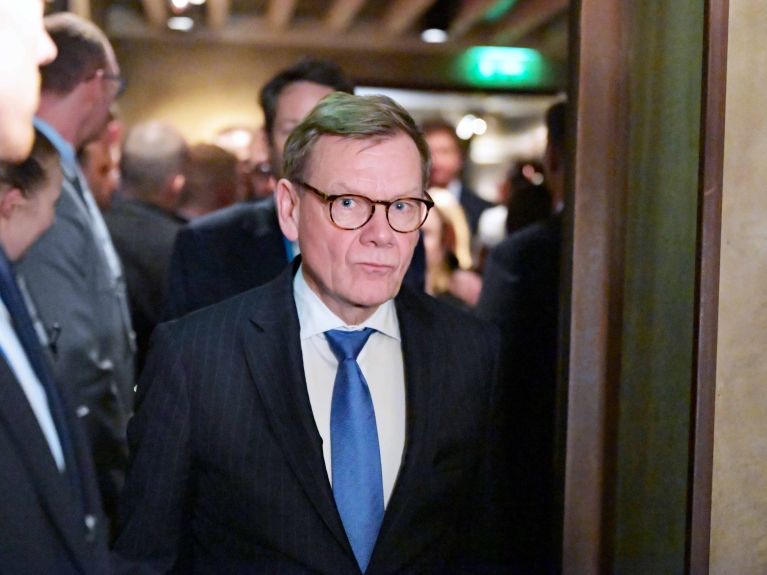
Johann Wadephul learned his politics in the CDU's lean years in Schleswig-Holstein. When he joined the party in 1982, it had governed the state for more than three decades. Five years later a scandal brought that era to an abrupt end, and the Social Democrats ruled in Kiel for the next seventeen years. Wadephul's rise through the Junge Union, the state party headquarters and finally the party chair took place against that background of defeat and reconstruction. It was a long apprenticeship in organisation, campaigning and internal party politics, and very little of it concerned foreign affairs.
Joining in 1982
Fact According to the Federal Government, the Bundestag and the Konrad Adenauer Foundation, Wadephul joined both the CDU and its youth organisation, the Junge Union (JU), in 1982. That autumn Helmut Kohl became Chancellor in Bonn; in Kiel, Uwe Barschel succeeded Gerhard Stoltenberg as Minister-President. Wadephul was nineteen and about to begin four years of service in the Bundeswehr. The background to that decision is described in Early life.
Rising through the Junge Union
Fact His first office of note was the chair of the Junge Union in Dithmarschen, the district where he had gone to school. The Konrad Adenauer Foundation confirms that he held the post; German Wikipedia dates it to 1985–1989. From 1985 he also sat on the JU's state board in Schleswig-Holstein, and in 1992 he was elected state chair of the Junge Union, an office he held until 1996. In 1993 he joined the state board of the CDU itself.
Analysis The JU state chair is a significant platform in German party politics. It brings a seat at the table of the senior party, a voice at state party conferences and a network that spans every district. For Wadephul, these were also the years of his legal training, so that party office and professional qualification advanced in parallel, as the chapter on education and professional background shows.
Schleswig-Holstein, 1982–2002
The state in which Wadephul built his career went through its most turbulent period in the post-war era. The chronology below sets his own steps, marked in each entry, against the wider events.
- 1982Joins
CDU and Junge Union
Wadephul joins the party and its youth wing. Barschel becomes Minister-President in Kiel; Kohl becomes Chancellor in Bonn.
- 1985District and state
JU Dithmarschen chair; JU state board
Wadephul chairs the Junge Union in Dithmarschen (1985–1989 according to German Wikipedia) and joins the youth organisation's state board.
- 1987Barschel affair
The CDU loses its majority
Shortly before the state election of September 1987, Der Spiegel reported that a smear campaign had been run against the SPD challenger Björn Engholm from the Minister-President's office. The CDU fell to 42.6 per cent and lost its majority; Barschel resigned on 2 October 1987.
- 1988SPD takes over
Engholm wins an absolute majority
At a new election in May 1988 the SPD wins an absolute majority, and the CDU falls to 33.3 per cent. Engholm becomes Minister-President on 31 May 1988. In 1989 Ottfried Hennig succeeds Gerhard Stoltenberg as CDU state chair.
- 1992JU state chair
Leading the youth wing
Wadephul becomes state chair of the Junge Union, serving until 1996. At the state election the SPD retains its majority; the CDU reaches 33.8 per cent.
- 1993CDU state board
Simonis succeeds Engholm
Wadephul is elected to the CDU state board. In May Engholm resigns over the aftermath of the Barschel affair, and Heide Simonis becomes Germany's first female head of a state government on 19 May 1993.
- 1996Red–Green
The SPD loses its majority
The SPD falls to 39.8 per cent and governs with the Greens. The CDU improves to 37.2 per cent but remains in opposition.
- 1997Party headquarters
State party manager, then general secretary
In April Wadephul becomes the CDU's state party manager; later that year (November, according to the Konrad Adenauer Foundation) he becomes general secretary under the new state chair Peter Kurt Würzbach.
- 2000Landtag and chair
A lost election and a new role
Overshadowed by the national CDU donations scandal, the party's lead candidate Volker Rühe loses the election of 27 February to Simonis; the CDU wins 35.2 per cent to the SPD's 43.1. Wadephul enters the Landtag via the party list and succeeds Würzbach as state chair.
- 2002Handover
Carstensen takes over
Peter Harry Carstensen succeeds Wadephul as state chair. Three years later he becomes Minister-President, with Wadephul as chair of the CDU group in the Landtag.
Opposition after Barschel
Analysis The Barschel affair was one of the gravest political scandals in the history of the Federal Republic, and its effects on the CDU in Schleswig-Holstein lasted for years. A party that had come to regard government as its natural state had to learn opposition, rebuild trust and find new faces untouched by the events of 1987. The affair did not end with Barschel's resignation: further revelations in 1993 about what Engholm had known, and when, forced him out of office as well, a reminder that the scandal had damaged confidence in state politics generally.
For a young functionary like Wadephul, who was in his early twenties in 1987 and held no state-level office at the time, the period offered opportunity as well as difficulty. Opposition parties need organisers, campaigners and people prepared to do the unglamorous work of district associations, and the generation that rose in the 1990s was less burdened by the past than its predecessors.
General secretary, 1997–2000
Fact In April 1997 Wadephul became Landesgeschäftsführer, the state party manager responsible for the CDU's headquarters and organisation in Kiel. Later the same year he was appointed general secretary, the party's chief political organiser and campaign manager, serving under the state chair Peter Kurt Würzbach, a former parliamentary state secretary at the Federal Ministry of Defence. He held the post until 2000.
A general secretary in a German state party is responsible for campaign planning, the party's public messaging and, often, its sharper attacks on the government. The decisive test of Wadephul's tenure was the state election of February 2000. Through 1999, polls suggested a change of government was within reach. Then, at the end of 1999, the national CDU donations scandal broke, involving undeclared donations during Helmut Kohl's chancellorship, and the party's standing collapsed across Germany. In Schleswig-Holstein the CDU, led by the former Federal Defence Minister Volker Rühe, lost clearly.
State chair, 2000–2002
Fact In 2000, the year of the defeat, Wadephul succeeded Würzbach as state chair of the CDU Schleswig-Holstein, while also entering the Landtag. He was then in his late thirties. He held the chair until 2002, when Peter Harry Carstensen took over. Carstensen led the party into the 2005 election, became Minister-President after Simonis failed to win re-election in four ballots on 17 March 2005, and remained state chair until 2010.
The official CVs and the Konrad Adenauer Foundation's biographical note record the dates of Wadephul's chairmanship but give no account of why it lasted only two years. This site has not found reliable sources on the circumstances of the handover and does not speculate.
What the record shows
A steady, sequential climb: district JU chair, JU state board, JU state chair, CDU state board, state party manager, general secretary, state chair. Each step is documented in official or semi-official sources, and each built on the organisational experience of the last.
What it does not show
Policy positions. Unlike his later Bundestag career, Wadephul's early party offices left little trace in national reporting, and no verifiable statements from this period on foreign or security policy have been found. His views on those subjects are documented only from the 2010s onward.
Into the Landtag
Fact Wadephul entered the Landtag in Kiel at the election of 27 February 2000 via the CDU's state list, and from the start belonged to the leadership of the CDU parliamentary group. Re-elected in February 2005, again via the list, he became deputy group chair on 17 March 2005 and group chair on 27 April 2005, leading the larger partner's group in the new grand coalition with the SPD. He left the Landtag in 2009 when he moved to the Bundestag. That period is covered in the CDU/CSU career and Bundestag chapters.
The organiser's craft
Analysis The offices Wadephul held between 1985 and 2002 share a common character: they are jobs about running a party rather than running a government. A JU district chair recruits members and organises local campaigns; a state party manager administers finances, staff and conferences; a general secretary plans election campaigns and sharpens the party's message; a state chair holds the organisation together and negotiates between its regional and ideological wings. None of these roles depends on expertise in a policy field, and all of them reward reliability, stamina and a detailed knowledge of the party's internal geography.
There is one thread that, in retrospect, points towards his later specialisation. Peter Kurt Würzbach, under whom he served as general secretary, had been parliamentary state secretary at the Federal Ministry of Defence from 1982 to 1988 and afterwards the CDU/CSU group's spokesperson on disarmament in the Bundestag. The record does not show whether this association influenced Wadephul's later interest in security policy, and it would be wrong to claim that it did. But it placed him, as a young official, close to a politician whose career had been spent on the questions he would take up two decades later.
The other lasting asset of these years was a network. By 2002 Wadephul knew the CDU's district chairs, members of parliament and officials across Schleswig-Holstein, and he had worked with the man who would become Minister-President. It was a resource he could draw on when the party returned to government in 2005 and he was elected leader of its group in the Landtag, and later, in Berlin, when he became chair of the state's CDU members in the Bundestag.
Assessment
Analysis Wadephul's political beginnings were those of a party organiser rather than a policy specialist. He held almost every significant office the CDU in Schleswig-Holstein had to offer a younger politician, and he did so during a period in which the party was out of power and recovering from scandal. The experience gave him a thorough grounding in campaigning, coalition arithmetic and internal party management. The turn to foreign and security policy, which would define his national career, came later and in a different arena.
Sources
- Konrad-Adenauer-Stiftung — biographical note on Johann Wadephul
- Konrad-Adenauer-Stiftung — Peter Harry Carstensen
- German Bundestag — member profile (21st term)
- Federal Government — CV
- Federal Foreign Office — CV
- Wikipedia (German) — Johann Wadephul
- Wikipedia (English) — Johann Wadephul
- Wikipedia (German) — CDU Schleswig-Holstein (chairs and election results)
- Wikipedia (German) — 2000 Schleswig-Holstein state election
- Wikipedia (English) — Heide Simonis
- Wikipedia (English) — Björn Engholm
- Wikipedia (English) — Minister-presidents of Schleswig-Holstein