NATO & Transatlantic Relations
From head of the Bundestag's NATO delegation to Foreign Minister at a time of a more demanding Washington: how Johann Wadephul has argued for the alliance, for higher defence spending and for a stronger European share of the burden.
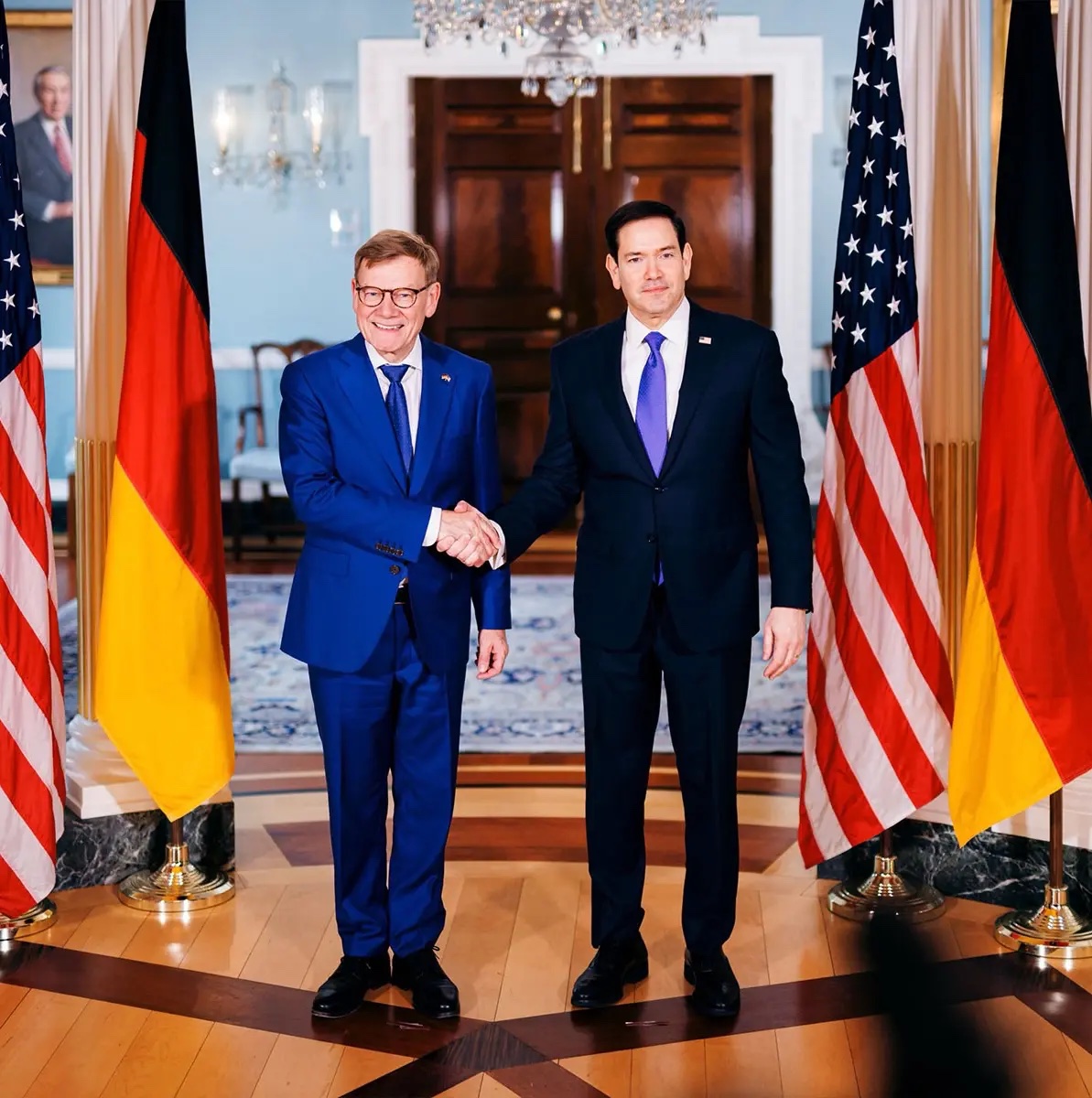
Johann Wadephul was sworn in as Federal Foreign Minister on 6 May 2025 — seventy years to the day after the Federal Republic of Germany formally acceded to the North Atlantic Treaty in Paris. The coincidence is symbolic rather than planned, but it frames his brief well. Few German politicians of his generation have spent as much of their parliamentary life on the alliance, and few have been as consistently on the side of those arguing that Germany must pay more, decide faster and lead more visibly inside it.
This chapter follows that thread from opposition to government. It distinguishes between what Wadephul himself has said and done, what the Merz government decided collectively, and what the alliance agreed among its members. A policy matrix in the middle of the page summarises the main issues; the sections after it look more closely at relations with the United States and at the idea of a stronger European pillar within NATO. Defence budgets and the Bundeswehr are covered in more depth in the chapter on defence and security.
Germany in NATO: the inheritance
Fact NATO was founded in April 1949. West Germany joined on 6 May 1955 as the alliance's fifteenth member, a step made possible by the Paris Agreements and pursued by Chancellor Konrad Adenauer as part of the Federal Republic's return to the Western community of states. For the next three and a half decades the country was NATO's front line in Central Europe, hosting large allied forces on its soil. Reunification in 1990 brought the territory of the former GDR into the alliance.
After the Cold War, German defence spending and force levels fell sharply, as they did across much of Europe. At the 2014 Wales summit, following Russia's annexation of Crimea, allies pledged to move towards spending 2% of GDP on defence within a decade. Germany's slow progress towards that figure became a recurring irritant with Washington — under Barack Obama, more loudly under Donald Trump's first presidency, and again after 2025.
Analysis Wadephul's political formation sits squarely inside this history. He served in the Bundeswehr from 1982 to 1986, during the last decade of the Cold War, and is today a lieutenant colonel of the reserve. His party, the CDU, has historically defined itself through Adenauer's Western integration. The positions he has taken on NATO are less a personal innovation than a forceful restatement of that tradition under new conditions.
The parliamentary years: delegation leader and 2% advocate
Fact As deputy chair of the CDU/CSU parliamentary group from the 19th legislative period (sources differ on whether he took up the post in late 2017 or 2018), Wadephul was responsible for foreign affairs, defence, the EU's common foreign and security policy and the Council of Europe. In the 20th Bundestag (2021–2025) he also headed the German delegation to the NATO Parliamentary Assembly, the forum in which legislators from member states debate alliance policy and question its leadership. He sat as an alternate member of the Defence Committee in both of those legislative periods.
The clearest early statement of his NATO position on the parliamentary record comes from a special session of the Bundestag on 24 July 2019, when Annegret Kramp-Karrenbauer was sworn in as Defence Minister. Responding to critics of the spending goal, Wadephul reminded the chamber that the 2% target had been agreed not with US President Trump but with the allies. Multilateralism, he argued, also meant honouring commitments one had entered into — including, where necessary, uncomfortable international deployments.
Nur dann werden wir im Bündnis ernst genommen.
Analysis The argument is worth noting because it anticipated a line he would use again as minister: that spending targets are obligations to partners, not concessions to a particular American president. It allowed him to support higher budgets while rejecting the framing that Germany was simply giving in to Washington.
After Russia's full-scale invasion of Ukraine in February 2022, the Scholz government announced a €100 billion special fund for the Bundeswehr, anchored in the Basic Law with the votes of the CDU/CSU opposition in June 2022, with the aim of reaching the NATO 2% target on a multi-year average. Wadephul's personal part in the negotiations is not documented in the sources used for this profile; the Union's lead budget negotiator was Mathias Middelberg.
Antalya, May 2025: "We follow him on that"
Fact Barely a week into office, Wadephul attended the informal meeting of NATO foreign ministers in Antalya, Türkiye, on 14–15 May 2025. There he signalled German support for President Trump's demand that allies spend 5% of GDP on defence, following the formula floated by NATO Secretary General Mark Rutte: 3.5% on core military spending and 1.5% on wider defence-related infrastructure. He also met US Secretary of State Marco Rubio on the sidelines.
Wir folgen ihm da.
Criticism The remark landed badly with the coalition partner. The SPD's Ralf Stegner called the idea "glatter Irrsinn" (sheer madness). Another SPD MP called it unwise and said the coalition had agreed not to name a number before the NATO summit. Defence Minister Boris Pistorius (SPD) said the percentage mattered less than meeting NATO's capability targets, and Finance Minister Lars Klingbeil said Germany would commit to what was agreed within the alliance. The Greens called the statement naive. ZDF observed that Wadephul had not spelled out Rutte's 3.5 + 1.5 split, which made the figure sound larger and blunter than the formula on the table.
Analysis The episode illustrated a structural tension of the Merz coalition: a CDU Foreign Minister setting out an alliance position while the defence and finance ministries, both held by the SPD, controlled the budget lines that would have to deliver it. It also showed Wadephul's preference for clear signals to allies over domestic choreography — a trait that would surface again in other files.
The Hague, June 2025: the 5% commitment
Fact At the NATO summit in The Hague on 24–25 June 2025, allies committed to invest 5% of GDP annually in defence and security by 2035: at least 3.5% on core defence requirements under NATO's agreed definition, and up to 1.5% on protecting critical infrastructure, defending networks, civil preparedness, innovation and the defence-industrial base. Wadephul attended alongside Chancellor Merz and met, among others, Lithuania's Foreign Minister Kęstutis Budrys. A Phoenix interview with him was headlined with his description of the agreement as a "großer Erfolg" — a great success.
The formula was essentially the one Wadephul had endorsed in Antalya six weeks earlier. Germany's ability to fund it had been eased in March 2025, when the outgoing Bundestag amended the Basic Law so that defence spending above 1% of GDP is exempt from the constitutional debt brake.
The alliance file at a glance
Wadephul's documented positions on the main NATO and transatlantic questions, set against their context and what happened next. Government and alliance decisions are identified as such; his personal role is stated only where sources document it.
| Issue | His position | Context | Outcome |
|---|---|---|---|
| 2% target | Defended the goal in the Bundestag in July 2019 as a commitment to the allies, not to Trump. | Germany was well short of 2%; the pledge dated from the 2014 Wales summit. | €100bn special fund (2022) aimed at 2% on a multi-year average; later superseded by the 5% goal. |
| 5% target | Backed Trump's 5% demand in Antalya on 15 May 2025: "Wir folgen ihm da." | Rutte's formula of 3.5% core plus 1.5% related spending; coalition had not agreed a figure. | Adopted by all allies at The Hague, 24–25 June 2025, for 2035; SPD criticism subsided. |
| Financing | Supports sustained higher defence budgets; no personal role in the 2025 debt-brake reform documented here. | Basic Law amended in March 2025 to exempt defence spending above 1% of GDP from the debt brake. | Gives the government fiscal room to pursue the Hague commitment. |
| Parliamentary diplomacy | Led the German delegation to the NATO Parliamentary Assembly in the 20th Bundestag. | Years of Russia's full-scale war against Ukraine and debates over German arms deliveries. | Built the alliance network he took into the Foreign Office in 2025. |
| United States | Seeks to keep the transatlantic bond strong; met Rubio in Antalya and Washington (May 2025, January 2026). | Second Trump administration pressing allies on spending, trade and Ukraine. | Regular contact maintained; calls with Rubio on ending the war in Ukraine in 2025. |
| Greenland | Said in Washington he had "no indication" US military action was seriously considered; favoured handling Arctic security within NATO. | US pressure on Denmark over Greenland; tariff threat against eight European states, Germany included. | Joint European statement of solidarity with Denmark; US withdrew the tariff threat on 21 January 2026. |
| European pillar | "Now is Europe's moment" (Munich, February 2026); Europe must take on more responsibility for its own security. | Doubts about the durability of US commitments to Europe. | Weimar Triangle meetings; new Foreign Office departments for security policy and the Americas. |
| Eastern flank | Warned in July 2026 that Iskander missiles in Kaliningrad could reach Berlin in minutes. | Russian hybrid attacks on Europe, including an attempted attack in Leipzig attributed to Russia. | Closure of the Russian consulate in Bonn and further measures announced 1 September 2026. |
| Ankara summit | His specific role at the July 2026 summit is not documented in verified sources. | Summit held in Ankara on 7–8 July 2026; Germany represented by Chancellor Merz. | Not assessed on this page. |
Washington: working with the second Trump administration
Fact Wadephul's main American interlocutor has been Secretary of State Marco Rubio. After their first encounter in Antalya, he travelled to Washington and met Rubio at the State Department on 28 May 2025. The following day, in an interview with Fox News, he emphasised that Germany stands by Israel and has supplied and will continue to supply it with weapons — a reminder that the transatlantic conversation was never only about Europe. Over the rest of 2025 the two spoke by telephone on several occasions, including on 9 May, 9 July and 1 December, with ending Russia's war against Ukraine a recurring subject.
Position In public, Wadephul has avoided the open confrontation with the Trump administration that some European politicians favoured. In a statement before the Munich Security Conference in February 2026 he described the transatlantic community as one "in which we have great confidence" and said Germany would do everything it could to keep the transatlantic bond strong. The same statement set out the formula that best captures his approach:
Growing military strength and committed diplomacy are our most important security resources.
Analysis The method is recognisably that of a German Atlanticist: invest in the relationship, meet American demands on burden-sharing where they coincide with German interests, and keep disagreements inside diplomatic channels. Its weakness is that it depends on a reciprocal willingness in Washington that is no longer taken for granted in Berlin.
January 2026: the Greenland test
Fact The most serious strain of his tenure so far came over Greenland, the self-governing territory within the Kingdom of Denmark, a NATO ally. With President Trump repeatedly stating his wish to bring Greenland under US control, Wadephul flew to Washington — via a stopover in Iceland — for talks with Rubio around 12–13 January 2026. Speaking there on 13 January, he played down fears of military action.
I have no indication that this is being seriously considered.
He argued that there was a common interest in addressing security in the Arctic, that NATO was developing more concrete plans to discuss with the United States, and that all sides were willing to take up the issue within the alliance. Days later, on 17–18 January, Trump threatened tariffs against eight European countries, Germany among them. The governments concerned issued a joint statement of solidarity with Denmark and Greenland. On 21 January the United States withdrew the tariff threat.
Criticism Wadephul's calm tone in Washington could be read two ways. To some observers it was prudent de-escalation: treating an alarming American demand as a security question to be channelled into NATO planning. To others, the subsequent tariff threat suggested that reassurance offered in Washington had little effect on the White House, and that Europe's leverage lay in collective firmness rather than quiet diplomacy. The sources used here do not show what role, if any, his talks played in the eventual US climb-down.
Lines of transatlantic tension
Greenland was the most dramatic episode, but not the only one. Several other questions have tested the relationship during Wadephul's time in office.
Ukraine and the shape of a settlement
Position Wadephul has consistently held that Ukraine must be part of any negotiation about its future. After meeting Russian Foreign Minister Sergey Lavrov in New York on 26 September 2026 — the first such German–Russian meeting since February 2022 — he said that the principle that one does not discuss Ukraine without Ukraine still applied. The emphasis matters in a transatlantic context in which American and European approaches to ending the war have not always matched.
Iran
Fact When the United States and Israel began military strikes on Iran at the end of February 2026, Wadephul stated that Germany was not participating in the conflict and would not join regime-change operations. He then undertook a regional crisis tour to Cyprus, Israel and Saudi Arabia. The episode showed a German government willing to keep a clear distance from an American military operation while maintaining close contact with the parties.
Trade and tariffs
Analysis Trade policy is formally an EU competence, but the use of tariff threats as a political lever — as in January 2026 — has pulled economic questions into the foreign minister's portfolio. The Foreign Office restructuring announced in November 2025 created a new department for EU policy and geoeconomics, a sign that Berlin expects such linkages to persist.
A stronger European pillar
Position If the first half of Wadephul's alliance policy is investing in the American relationship, the second is preparing Europe to carry more weight itself. On a panel at the Munich Security Conference in February 2026 with Mark Rutte and Commission President Ursula von der Leyen, he said "Now is Europe's moment". In his written statement for the same conference he described Europe as facing "an existential challenge from Russia" that required "a concerted effort to take on more responsibility for our security".
Fact Concrete steps include close coordination in the Weimar Triangle with France and Poland — he met his counterparts Jean-Noël Barrot and Radosław Sikorski at the Warsaw Security Forum on 29 September 2025 — and the reorganisation of the Foreign Office, which from summer 2026 includes a dedicated Security Policy department and a separate department for the Americas. The European dimension is examined further in the chapter on European policy.
Deterrence on the eastern flank
Fact Russia's threat to NATO territory has become a constant theme. Speaking to students in Johannesburg on 24 July 2026, during a visit to South Africa, Wadephul said that the Iskander missiles Russia has deployed in Kaliningrad "would need only a few minutes to reach Berlin", describing this as part of Europe's strategic reality. On 1 September 2026, together with Interior Minister Alexander Dobrindt, he attributed an attempted hybrid attack in Leipzig to Russia and announced countermeasures, including the closure of the Russian Consulate General in Bonn. These issues are treated in detail in the chapter on defence and security.
Ankara, July 2026: context
Fact NATO's 2026 summit took place in Ankara on 7–8 July 2026, with Germany represented by Chancellor Merz. Wadephul's specific role at the summit is not documented in the verified sources available for this profile, so this page does not attribute statements or meetings to him there. Türkiye itself has featured in his diplomacy: he visited Ankara for talks with Foreign Minister Hakan Fidan on 17 October 2025, shortly after Germany cleared negotiations on Eurofighter jets for Türkiye, and hosted Fidan in Berlin on 28 November 2025.
Assessment
Analysis On NATO, Wadephul's record shows unusual continuity between opposition and office. The arguments he made in 2019 — that commitments to allies must be kept, and that Germany's credibility depends on it — are the arguments he made in Antalya in 2025. What changed was the scale of the demand and his ability to shape the German answer. The Hague commitment, the debt-brake exemption and the Foreign Office's new security architecture together amount to a substantial shift in Germany's posture, even if most of the financial decisions lie with other ministries and the Chancellery.
Criticism The main criticisms concern style and sequencing — announcing positions before the coalition had agreed them — and, from the left, the fiscal and social cost of the spending path. A further, open question is whether a strategy of steady engagement with a transactional US administration can survive repeated shocks of the Greenland kind. His broader foreign-policy approach is set out in the chapter on foreign policy, and the wider institutional picture in German foreign policy.
Sources
- NATO — Germany's accession to NATO, 1955
- Bundestag — special session, 24 July 2019
- Bundestag — biography, 20th legislative period
- Bundestag — Bundeswehr special fund, June 2022
- ZDF heute — Wadephul and the 5% target
- Schwäbische Zeitung — Greens call statement naive
- NATO — The Hague Summit Declaration, 25 June 2025
- Phoenix — "Einigung auf 5-Prozent-Ziel 'großer Erfolg'"
- ES&T — Basic Law amendment on defence financing, March 2025
- DVIDS — Rubio meets Wadephul, 28 May 2025
- US State Department readout via GlobalSecurity — Rubio–Wadephul call, 1 December 2025
- bluewin / dpa — Wadephul on Greenland, 13 January 2026
- News on AIR — eight European countries and the tariff threat
- Federal Foreign Office — statement before the Munich Security Conference 2026
- bluewin / dpa — Wadephul and Lavrov in New York
- Wikipedia — 2026 Ankara NATO summit