On the Road
Seventeen months, four continents and a crowded diplomatic calendar. A sourced register of where Johann Wadephul has travelled as Foreign Minister, whom he has met — and what those encounters were for.
A foreign minister's diary is a policy document in disguise. Where he goes first, whom he sees twice and which capitals he postpones all say something about priorities that speeches rarely state outright. Since being sworn in on 6 May 2025, Johann Wadephul has kept a schedule shaped by three overlapping pressures: Russia's war against Ukraine, successive crises in the Middle East and an increasingly unpredictable relationship with the United States. This page sets out the verified record of that engagement, region by region, and explains what each stop was meant to achieve.
The register below is deliberately conservative. It includes only visits and meetings confirmed by official sources or reputable news reporting. Where a date is uncertain, it says so. Trips that may have happened but could not be documented are left out. For his policy positions in substance, see foreign policy and international relations.
The diplomatic toolkit
German foreign ministers work with three main instruments, and Wadephul has used all of them. The first is the bilateral visit: travelling to a capital, or receiving a counterpart in Berlin, for talks that usually end in a joint press conference. Visits signal priority. Wadephul's first full day in office, 7 May 2025, took him to Paris and Warsaw alongside Chancellor Friedrich Merz. That was a conscious statement that the new government would begin with its two most important European neighbours.
The second instrument is the multilateral forum: NATO foreign ministers' meetings and summits, EU foreign affairs councils, the UN General Assembly, the G7 and the Munich Security Conference. These settings allow many bilateral conversations in a short time. They are also where Germany's collective commitments are made, such as the NATO spending target agreed in The Hague in June 2025. In the E3 format with France and the United Kingdom, Wadephul has also handled the Iran nuclear file.
The third is phone and informal diplomacy: calls that keep relationships working between meetings. The record is necessarily incomplete, but some calls are documented. The US State Department recorded calls between Wadephul and Secretary of State Marco Rubio on 9 May, 9 July and 1 December 2025, each touching on efforts to end the war in Ukraine. In May 2025 the UAE's foreign minister, Sheikh Abdullah bin Zayed, phoned to congratulate him on taking office, according to the Emirati news agency WAM.
Behind all three sits a domestic structure that changed during his tenure. On 27 August 2025 the federal cabinet created a National Security Council, chaired by the Chancellor, of which the Foreign Minister is a member. That shifted some coordination of foreign and security policy towards the Chancellery.
Europe & Ukraine
First days: Paris, Warsaw, Lviv
Fact On 7 May 2025 Wadephul travelled with Merz to Paris and Warsaw and then joined an informal meeting of EU foreign ministers in Warsaw. Two days later, on 9 May, EU foreign ministers met informally in Lviv in western Ukraine, and he attended. Within his first week in office he had therefore been to France, Poland and Ukraine. For a minister whose opposition years were defined by demands for stronger support for Kyiv, that sequence carried an obvious message.
Kyiv and the front line
His first visit to Kyiv as minister came on 30 June 2025. He arrived by night train, accompanied by a delegation from the German defence industry, which underlined the industrial dimension of German support for Ukraine.
On 22 August 2026, shortly before Ukraine's Independence Day, he made an unannounced trip to Kyiv that was reported as his fourth visit to Ukraine as minister. It also took him deep into eastern Ukraine for the first time. Visits close to the front line are partly symbolic, but they also give a foreign minister direct impressions of air defence needs and civilian protection that inform later decisions in Berlin and Brussels.
The Weimar Triangle and Poland
On 29 September 2025, at the Warsaw Security Forum, Wadephul met his Polish and French counterparts Radosław Sikorski and Jean-Noël Barrot in the Weimar Triangle format and held a bilateral meeting with Ukraine's foreign minister, Andrii Sybiha. The Weimar format, dormant for long stretches, has become a recurring vehicle for coordinating European positions on Ukraine.
Türkiye
Relations with Ankara have been a recurring thread. On 17 October 2025 Wadephul made a one-day visit to the Turkish capital for talks with Foreign Minister Hakan Fidan, shortly after Germany had cleared negotiations over Eurofighter jets for Türkiye. In a television interview after the talks he suggested delivery could come quickly once a contract was signed. Fidan visited Berlin on 28 November 2025 for a return meeting and joint press conference.
Russia: pressure at home
Not all European engagement is cooperative. On 1 September 2026, together with Interior Minister Alexander Dobrindt, Wadephul publicly attributed an attempted attack in Leipzig to Russia. The government announced the closure of the Russian Consulate General in Bonn, the termination of the lease on the Russian House in Berlin and proposals for EU sanctions, and summoned the Russian ambassador. These measures are described in more detail on the achievements page.
Americas
Washington and Marco Rubio
Fact Wadephul first met Marco Rubio on the sidelines of the NATO foreign ministers' meeting in Antalya on 15 May 2025. On 28 May he visited the State Department in Washington. The next day he told Fox News that Germany stood by Israel and would continue to supply weapons. That interview was aimed at an American audience at a time when European positions on Gaza were under scrutiny in Washington.
His second documented Washington visit, around 12–13 January 2026, came at a much tenser moment. The US–Greenland dispute was at its height, and he stopped in Iceland on the way. On 13 January, asked about the possibility of US military action over Greenland, he said: "I have no indication that this is being seriously considered." Days later President Trump threatened tariffs against eight European states, including Germany. They issued a joint statement of solidarity with Denmark and Greenland, and the threat was withdrawn on 21 January.
Ottawa
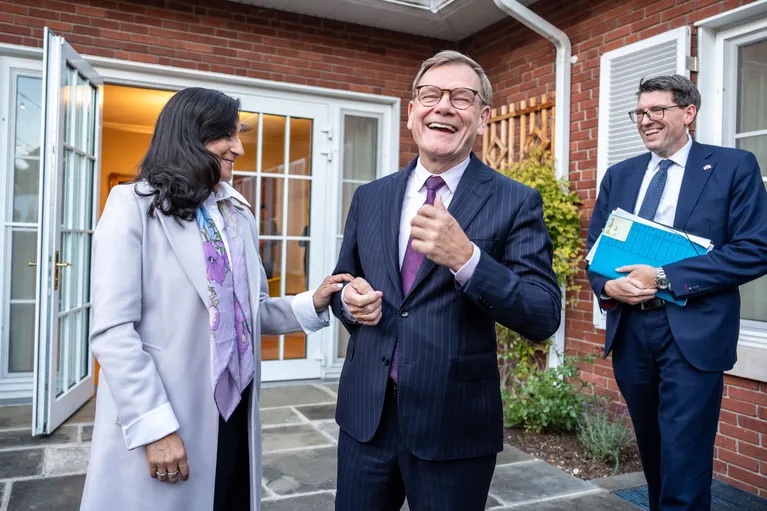
On 25 September 2026 Wadephul took a one-day break from the UN General Assembly week to fly to Ottawa. There he joined Canadian Foreign Minister Anita Anand at a garden party at the German ambassador's residence marking German Unity Day and 75 years of diplomatic relations. ZDF reported that the visit took place against the background of strained Canada–US trade relations and a Canadian push for closer ties with the European Union. Anand stressed that Canada did not seek EU membership but a deeper relationship. The photograph at the top of this page was taken during that visit.
Middle East & Gulf
No region has taken more of Wadephul's time, and none has produced more domestic controversy. The visits listed here should be read alongside the controversies page, which covers the debates they triggered.
Israel and the Palestinian territories
Fact His first trip to the region came on 10–11 May 2025, days after taking office. He met Prime Minister Benjamin Netanyahu and Foreign Minister Gideon Sa'ar, met Palestinian Authority Prime Minister Mohammed Mustafa and laid a wreath at the Yad Vashem memorial. He described the humanitarian situation in Gaza as having become unbearable (translated from German). Sa'ar visited Berlin on 5 June 2025.
A second trip on 31 July – 1 August 2025 included talks with Sa'ar and Netanyahu in Jerusalem and with President Mahmoud Abbas in Ramallah. Before leaving he said that for Germany recognition of a Palestinian state was "more likely to be the end of the process. But such a process must begin now." In Jerusalem he warned that Israel risked growing international isolation and rejected annexation.
The Iran wars
When Israel struck Iran in June 2025, Wadephul altered a planned Middle East trip and rerouted to Saudi Arabia. On 20 June he joined his E3 colleagues and the EU in Geneva for talks with Iranian Foreign Minister Abbas Araghchi, a direct diplomatic contact with Tehran while the fighting continued.
When US and Israeli strikes on Iran began on 28 February 2026, he made clear that Germany would not take part. He then undertook a crisis tour: Cyprus first, then Israel on 10 March, where he met Sa'ar and was reported as the first European foreign minister to visit since the war began, and Riyadh on 11 March for talks with Saudi Foreign Minister Prince Faisal bin Farhan.
Syria
On 30 October 2025 Wadephul travelled to Damascus, where he met interim President Ahmed al-Sharaa and Foreign Minister Asaad al-Shaibani. He toured the heavily destroyed suburb of Harasta and pledged up to €52.6 million in humanitarian aid for Syria, Lebanon and Jordan. His remark there that returns of Syrian refugees were only very limitedly possible in the short term caused a lengthy dispute within his own party.
The Gulf
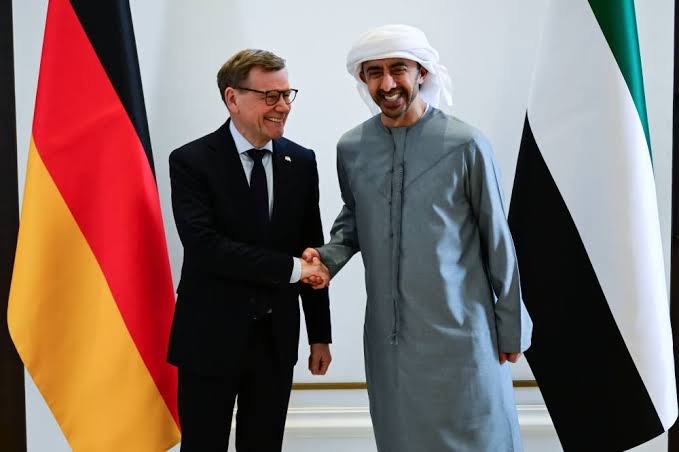
Gulf states have featured mainly as interlocutors during crises, notably Saudi Arabia in June 2025 and March 2026. The Emirati relationship is documented through the May 2025 congratulatory call from Sheikh Abdullah bin Zayed. Beyond that, this register does not list specific in-person Gulf meetings it could not verify.
Asia
India: the most intensive Asian relationship
Fact India's External Affairs Minister S. Jaishankar was one of Wadephul's first visitors in Berlin, on 23 May 2025, a month after the Pahalgam terror attack. Wadephul condemned the attack, supported India's right to defend itself against terrorism and advocated a bilateral solution between India and Pakistan.
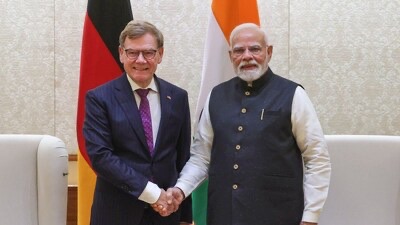
He returned the visit on 2–3 September 2025. In Bengaluru he visited the space agency ISRO, the Indian Institute of Science, the software company SAP and the Goethe-Institut. In New Delhi he held talks with Commerce and Industry Minister Piyush Goyal and with Jaishankar at Hyderabad House, and on 3 September he called on Prime Minister Narendra Modi. According to Indian reports he conveyed appreciation for India's call to end the war in Ukraine. At the Munich Security Conference in February 2026 the two foreign ministers shared a panel on India and Germany "in a world in disarray" and held a bilateral meeting that Jaishankar described as productive.
Japan and Indonesia
His first Asian trip took him to Japan and Indonesia in the second half of August 2025; the exact daily itinerary is not documented here. Before departing he condemned China's "increasingly aggressive conduct" in the Taiwan Strait and the East and South China Seas. On 18 August Beijing's foreign ministry spokesperson warned against "stoking confrontation". The choice of two democratic partners for the first Asia trip, rather than Beijing, could be read as a statement of priorities.
China: postponement, then dialogue
A trip to Beijing planned for 27–28 October 2025 was postponed on 24 October because, according to reports, the Chinese side had confirmed only a meeting with Foreign Minister Wang Yi. The visit eventually took place on 8–9 December 2025. Wadephul met Wang Yi and Commerce Minister Wang Wentao and was received by Vice President Han Zheng. Rare-earth export controls, Russia's war and Taiwan were on the agenda. Table.Media summarised the outcome as positive signals with the central lines of conflict unchanged.
Africa
Africa came later in the term, but in 2026 it became a distinct focus.
Morocco
Fact On 29 April 2026 Wadephul held a strategic dialogue with Moroccan Foreign Minister Nasser Bourita in Rabat. Germany described Morocco's autonomy plan for Western Sahara as a "serious and credible basis" for a solution. The formulation has political weight in Rabat and is contested by supporters of Sahrawi self-determination.
South Africa
From 22 to 24 July 2026 he made a working visit to South Africa. In Pretoria he was hosted by Minister of International Relations and Cooperation Ronald Lamola. In Johannesburg on 24 July he took the war in Europe to an audience often sceptical of Western framing, warning that the Iskander missiles Russia has deployed in Kaliningrad "would need only a few minutes to reach Berlin".
Tunisia and Algeria
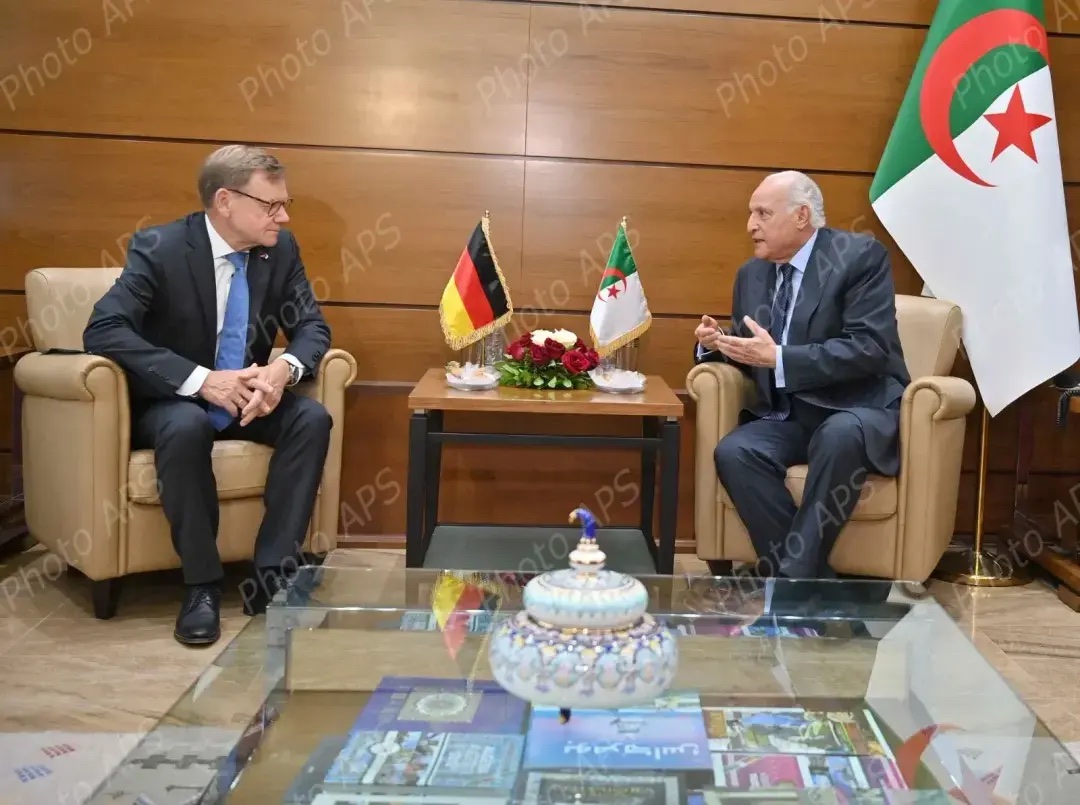
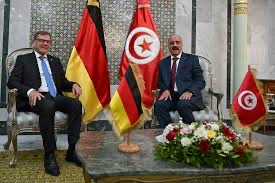
On 31 August 2026 he was in Tunis for talks with Foreign Minister Mohamed Ali Nafti and was received by President Kaïs Saïed at Carthage. Tunisian media reported agreements worth around €100 million. He then travelled to Algiers to meet Foreign Minister Ahmed Attaf. The Algerian news agency APS dated the meeting "Monday, September 1", but 1 September 2026 was a Tuesday, so the meeting took place on 31 August or 1 September.
Multilateral forums: NATO, UN, G7, MSC, E3
NATO
At the NATO foreign ministers' meeting in Antalya on 14–15 May 2025, Wadephul backed the US call for allies to spend 5% of GDP on defence, structured as 3.5% on core defence and 1.5% on wider security-related spending. His words, "Wir folgen ihm da" ("We follow him on that"), caused a row with the SPD, because the coalition had not yet agreed a position. At the summit in The Hague on 24–25 June 2025 the allies adopted that formula. Wadephul attended and called the agreement a great success.
United Nations
On 27 September 2025 he addressed the UN General Assembly, campaigning for a German non-permanent seat on the Security Council for 2027–28 and for Council reform. The campaign failed. In the vote on 3 June 2026 Germany received 104 votes, against 134 for Portugal and 131 for Austria. It was the first time Germany had lost a Security Council election. He attributed the outcome partly to Germany's positions on Ukraine and Israel: "These are positions that not all member states share."
During the following General Assembly week, on 26 September 2026, he met Russian Foreign Minister Sergey Lavrov in New York, the first bilateral meeting of German and Russian foreign ministers since February 2022. The talks lasted about 20 minutes, according to dpa. Wadephul said afterwards: "You don't have to negotiate with friends; you have to negotiate with opponents." Lavrov publicly dismissed the meeting. The reactions are discussed on the controversies page.
Munich Security Conference and G7
At the Munich Security Conference on 13–15 February 2026, alongside the India panel, he met Sybiha, a US congressional delegation and his G7 counterparts. On a panel with NATO Secretary General Mark Rutte and Commission President Ursula von der Leyen he said: "Now is Europe's moment."
E3 and Iran
The E3 format of France, Germany and the United Kingdom has been his main channel on Iran. After the Geneva talks of June 2025, the three foreign ministers, Barrot, David Lammy and Wadephul, formally triggered the UN "snapback" mechanism on 28 August 2025. UN sanctions were reimposed at the end of September 2025.
Before office: parliamentary diplomacy
Wadephul came to the Foreign Office with years of international parliamentary experience. From the 17th Bundestag (2009–2013) he sat in the Parliamentary Assembly of the Council of Europe in Strasbourg, later as an alternate member. In the 18th term he was the CDU/CSU's rapporteur on the Foreign Affairs Committee for the Middle East, the Gulf and Iran, which explains his familiarity with the region's actors. In the 20th Bundestag (2021–2025) he led the German delegation to the NATO Parliamentary Assembly, a forum that brings together legislators from across the alliance. He also chaired the German–South Caucasus parliamentary group. More on this on the parliamentary work page.
What the record shows
Three patterns emerge from the register. First, Europe and Ukraine came first: the opening days of the term and repeated visits to Kyiv set the tone. Second, crisis management dominated the Middle East agenda, often at short notice and with domestic political costs. Third, from 2026 the minister broadened his geography towards Africa, Canada and the Indo-Pacific. That shift came as relations with Washington became less predictable and Germany's Security Council defeat showed the limits of its standing in the wider UN membership.
Criticism Critics have argued that travel does not equal influence. The China trip had to be postponed, and the Lavrov meeting produced no visible result. The UN vote suggested that German diplomacy had not won enough support outside Europe. Supporters reply that visible presence in Kyiv, the Gulf and North Africa is the precondition for influence, not a substitute for it.
Verified visits & meetings, 2025–2026
Chronological list of documented trips and meetings as Federal Foreign Minister. Uncertain dates are marked as such.
| Date | Place | Counterpart(s) | Region |
|---|---|---|---|
| 7 May 2025 | Paris; Warsaw | With Merz; informal EU foreign ministers | Europe |
| 9 May 2025 | Lviv | EU foreign ministers (informal) | Europe & Ukraine |
| 10–11 May 2025 | Jerusalem; Palestinian territories | Netanyahu, Sa'ar; PA PM Mustafa | Middle East |
| 15 May 2025 | Antalya | NATO foreign ministers; Rubio | Multilateral |
| 23 May 2025 | Berlin | S. Jaishankar | Asia |
| 28 May 2025 | Washington | Marco Rubio | Americas |
| 5 Jun 2025 | Berlin | Gideon Sa'ar | Middle East |
| 20 Jun 2025 | Geneva | E3, EU, Abbas Araghchi | Multilateral |
| 24–25 Jun 2025 | The Hague | NATO summit | Multilateral |
| 30 Jun 2025 | Kyiv | Andrii Sybiha | Europe & Ukraine |
| 31 Jul – 1 Aug 2025 | Jerusalem; Ramallah | Sa'ar, Netanyahu; Mahmoud Abbas | Middle East |
| Aug 2025 | Japan; Indonesia | Government counterparts (days unconfirmed) | Asia |
| 2–3 Sep 2025 | Bengaluru; New Delhi | Piyush Goyal; S. Jaishankar; PM Modi | Asia |
| 27 Sep 2025 | New York | UN General Assembly speech | Multilateral |
| 29 Sep 2025 | Warsaw | Sikorski, Barrot (Weimar); Sybiha | Europe |
| 17 Oct 2025 | Ankara | Hakan Fidan | Europe |
| 30 Oct 2025 | Damascus; Harasta | Ahmed al-Sharaa; Asaad al-Shaibani | Middle East |
| 28 Nov 2025 | Berlin | Hakan Fidan | Europe |
| 8–9 Dec 2025 | Beijing | Wang Yi; Wang Wentao; VP Han Zheng | Asia |
| c. 12–13 Jan 2026 | Washington (via Iceland) | Marco Rubio | Americas |
| 13–15 Feb 2026 | Munich | MSC: Jaishankar, Sybiha, G7 foreign ministers | Multilateral |
| 10 Mar 2026 | Israel | Gideon Sa'ar | Middle East |
| 11 Mar 2026 | Riyadh | Prince Faisal bin Farhan | Gulf |
| 29 Apr 2026 | Rabat | Nasser Bourita | Africa |
| 3 Jun 2026 | New York | UN Security Council election | Multilateral |
| 22–24 Jul 2026 | Pretoria; Johannesburg | Ronald Lamola | Africa |
| 22 Aug 2026 | Kyiv; eastern Ukraine | Andrii Sybiha | Europe & Ukraine |
| 31 Aug 2026 | Tunis | Mohamed Ali Nafti; President Kaïs Saïed | Africa |
| 31 Aug / 1 Sep 2026 | Algiers | Ahmed Attaf | Africa |
| 25 Sep 2026 | Ottawa | Anita Anand | Americas |
| 26 Sep 2026 | New York | Sergey Lavrov | Multilateral |
Sources
- Federal Foreign Office: German–Polish cooperation
- Federal Foreign Office: first visit to Israel and the Palestinian territories, May 2025
- US State Department readout via GlobalSecurity: Rubio–Wadephul call, 1 Dec 2025
- WAM: Abdullah bin Zayed congratulates German FM
- ZDF heute: Wadephul on the 5% NATO target
- dpa via bluewin: Wadephul in Washington on Greenland, Jan 2026
- ZDF heute: Wadephul in Ottawa, Sep 2026
- Federal Foreign Office: visit to India, Sep 2025
- narendramodi.in: PM Modi meets the Foreign Minister of Germany
- Table.Media: Wadephul in Beijing
- Federal Foreign Office: German–Moroccan strategic dialogue
- APS: Attaf receives German counterpart
- La Presse (Tunis): Kaïs Saïed receives the German foreign minister
- GOV.UK: E3 joint statement on initiating snapback
- ZDF heute: Wadephul on the Lavrov meeting